Showing posts with label Australian. Show all posts

Review: Force and Fraud: A Tale of the Bush (1865) by Ellen Davitt


I believe that the first time I heard of Force nd Fraud  being referenced was in the acknowledgements section of a novel by Kerry Greenwood, one of my faviourite Australian authors. When I sought mor einformation about the novel, I found that it is often regarded as Australia's first crime novel, with a female author no less. This was one of those instances where what the book represents was the key driver in me picking this one up to read. 


Force and Fraud is the unravelling of a mystery surrounding the brutal murder of Angus McAlpin, a farm owner in rural Australia whose daughter Flora was forbidden by him to marry her love Herbert Lindsay. Suspicion, and eventually arrest for murder, naturally befall Herbet Lindsay and Flora engages her late father's agent Pierce Silverton to assist in proving Herbert's innocence. As the mystery unfolds, suspicion falls on several characters whose motives gradually emerge, until the truth of who killed McAlpin and why is eventually revealed (no spoilers, but it also wasn't a surprise). 


I enjoyed the idea of Force and Fraud more than I enjoyed reading it.


That feels a little unfair because I so admite Force and Fraud and Ellen Davitt for what she achieved. A woman writing crime fiction in colonial Australia at a time when the genre itself didn't really exist in Australian writing yet. She set the foundation for much of what I now love to read. There is a rich tradition of detective fiction in Austalia now (think Kerry Greenwood, Sulari Gentill) and Ellen Davitt paved the way.


The novel itself, however, was harder work than I expected. I found myself skipping the occasional passage simply because it felt repetitive or slow. I wonder if that's partly because Force and Fraud was originally serialised in Australian Journal: A Weekly Journal of Australian Literature, Science and the Asrts (1865) before it was released as a novel. I've noticed something similar in another serialised works I read recently, North and South. Chapters often end with a dramatic hook to entice readers back for the next instalment which loses its impact when read as a whole work. They also tended to linger a little scenes or rcharacters reflections in a way that made the novel feel a little plodding at times, duiluting the momentum of the novel. 


Nonetheless, I'm glad I read Force and Fraud. It offered me a fascinating glimpse into colonial Australia. It's so fascinating to me to imagine what life was like in times past and think about actual people living their daily reality in the same way that I do, but insuch different circumstances and surroundings. It's not a favourite but as a piece of Australian literary history it was worth the effort.


2/5 A bit of a miss for me, despite appreciating it as a piece of Australian litery history.

Review: The Deadly Dispute by Amanda Hampson, an Australian historical cosy detective novel


I read The Tea Ladies and A Cryptic Clue earlier in the year and really liked the whole vibe of the Tea Ladies series so I was pretty confident I’d enjoy this one and I did. The Deadly Dispute is fun and just the right kind of cosy crime to sink into on a lazy afternoon.


This time the tea ladies get tangled up in something a bit more dangerous. Hazel has a new job as a tea lady for the workers union on the docks. It isn't what she is used to, but Hazel being Hazel, sets out to make the most of it. It becomes more dangerous though when a dead body turns up and ther eis talk of missing gold from a ship that has come in. Of course Hazel starts asking questions, which inevitably leads to danger. One mystery is never enough of course. Irene becomes involved in troubles related to her employer's attempt at expanding her brothel empire and Betty falls into personal troubles when she reflects on her past and what she has missed. Things get really tense when Hazel disappears, forcing the others to pool their wits to rescue her. 


The characters remain the best part of the series. They are ridiculously loveable, even when they veer into caricature at times. Hazel, Betty, Merle and Irene are flawed, funny, and loyal, and watching them navigate danger while still managing to sip tea and throw shade at each other is exactly what makes this series so enjoyable.


The mystery is satisfying without ever being too heavy. Amanda Hampson keeps things moving. She gives things enough danger to feel the stakes while still keeping the cosy, nostalgic feel of 1960s Sydney and the gentle humour that makes the series so comforting.


Overall, this series continues to be a reliable comfort read. Nothing wildly surprising, but consistently enjoyable. If she keeps writing them, I’ll happily keep picking them up.


3 stars: It was good - enjoyable but forgettable.


Review: Everyone this Christmas Has a Secret by Benjamin Stevenson


I picked this up expecting something fun and quick and that is what I got. Everyone This Christmas Has a Secret sits firmly in the nlight entretainment zone and I mean that in a genuinely nice way. It is the kind of book you can zoom through in an afternoon because its fun and silly and you don't have to think very hard. Sometimes that is exactly what you want and need, especially at the end of the year when your brain has quietly tapped out.


Benjamin Stevenson has an easy chatty writing style, and that is still one of the best things about this series. The narrator's voice is strong and well defined. Stevenson keeps things moving along, keeps the jokes coming and gives you just enough mystery to feel like you are solving something without ever being stressed about it. 


That said, I am starting to feel like the charm of this series is wearing slightly thin. Like a lot of these cosy detective series, the more books there are, the more you feel the formula showing through. The characters still make me smile but some of the spark from the earlier books has faded a bit. I found myself caring less about the actual plot and even finding the fun approach a little less.... funny.


Still, I enjoyed it. It was exactly the right book coming into the end of a tiring year. If you go in wanting something light, warm and a bit ridiculous, it absolutely does the job. I just hope the next one shakes things up a little, because I would love to feel that early-series energy again.


3 stars: It was good - enjoyable but forgettable


Review: 100 Years of Betty by Debra Oswald


100 Years of Betty isn’t high-brow literary fiction and it doesn’t need to be. It’s warm, engaging, and I really enjoyed it. From the first chapter I connected with Betty, not because I’ve lived her life or even experiences 1/3 of what she has, but because Debra Oswald writes her with such humanity that you feel you could bump into her at the shops and strike up a chat.


Betty’s life begins in wartime London, a childhood shaped by the chaos and fear of the Blitz and the slow disintegration of her family under the strain of war and poverty. As a young woman she migrates to Australia in search of something more and begins (bravely in my mind) begins to build a new life in an unfamiliar country. Across the decades we see her navigate love and loss through multiple marriages, raise her children, and weather the quiet triumphs and disappointments that come with time. Betty's life is one of resilience and reinvention. 


One of the things Oswald does beautifully is show the role of chance in our lives. I once heard (and I wish I could remember where) that life is essentially a set of experiences that we tell ourselves stories about, so we can understand and ourselves better. It's an idea that's always struck me and I keep in mind when I am experiencing something challenging or stressful. That idea threads through Betty’s life. She makes choices but she’s also shaped by accidents, encounters, and the circumstances she finds herself in. Looking back, she pieces these moments together into her own narrative, and we see her come to understand who she is.


Reading it felt a little like a time travel novel except we move through time in the right direction. We watch Betty live through decades of change, each new era bringing shifts in social expectations, opportunities, and challenges. I felt joy and heartbreak watching her grow into her true self across all those years, especially as the world around her changes. We particularly see this shift almost immediately after her children are grown and she travels for the first time, moving to another content, to form connections and create a new family for herself, for a time. This moment felt to me like the most jarring or abrupt development in her character. I understand the change is big and abrupt because of the point in her life where she is free, without the responsibility of caring for her children, to finally put herself and her interests first.


One of the storylines that particularly resonated with me was about forced adoption. In a previous role, I worked in a not-for-profit organisation that supported people separated through forced adoption, and the emotions in this part of the book rang true. Oswald captures the pain, the complexity, and the lifelong impact without turning it into melodrama.


At its heart, this is also a story about women’s liberation. It shows how women have seen ourselves over time, how society has seen us over time, and how we have come to expect more from our lives. Through Betty, we see those changes unfold in small, everyday ways. Her confidence shifts, she becomes self-reliant and she knows she deserves and then expects respect.


And who doesn't doesn't love an elderly lady willing to experiment with hallucinogens. 


100 Years of Betty comes highly recommended by me.

Review: The Good People by Hannah Kent


Hannah Kent is one of my favourite authors. I’ve read all of her novels and her memoir. I love the way her writing seems to inhabit a time and place so completely that you can feel as though you are there. When you read her books you can see the world she describes, feel the damp air in your lungs, and experience the feelings and thoughts of the characters, right down to their bones. I saw her speak recently at the Sydney Writers’ Festival and she was just as lyrical and insightful in person as she is on the page.

But The Good People was, surprisingly, my least favourite of her books.

Set in rural Ireland in the 1820s, the story follows Nora, Mary, and Nance, whose lives become entangled through the care of a Nora's sickly young grandson, Micheal after Nora's husband unexpectedly passes away. Nora comes to believe that the “good people” (fairies) might be to blame for his condition, and the women take increasingly desperate steps to help him. 

Kent’s writing is, as always, richly atmospheric. She describes peat smoke curling from the hearth, mist hanging over green valleys, the smell and feeling of the wet and damp earth, and the rhythms of rural life in a way that feel so authentic that you can almost imagine that you are living them yourself. 

The book has a very slow pace which fits this setting. We experience the pace of a rural village in the Irish past and observe the seasonal change and the unchanging superstitious belieds of the community.  But for me, the pace felt a little too slow. I found myself skipping ahead a few pages here and there (and then sheepishly going back because guilt wouldn’t let me cheat properly). I didn’t connect deeply with any of the characters, which made the unhurried unfolding of events harder to settle into. In her other novels, I’ve always found a character or a thread of emotion that I have connected with. Here, I just didn't care as much as I needed to to remain in the story.

The ending also didn’t quite land for me. Without giving too much away, it felt oddly abrupt and left me feeling unsatisfied. That may well have been Kent’s intention, after all, the story is based on a real historical case, but I missed the sense of emotional connection that I’ve come to expect from her.

Still, even a Hannah Kent novel that doesn’t quite work for me is a novel worth reading. The writing alonehas the ability to embed you in a historical moment and I admire this so much in her books. If I had to summarise The Good People, I would say that it is a slow-burn immersion into a past world where folklore and reality blur, but for me it lacked the heartbeat that made Burial Rites and Devotion so unforgettable.

And now, having read all of Hannah Kent’s books, I’m left with the realisation that I’ll have to wait for her to write another before I can lose myself in her words again.


Review: The Mystery Writer by Sulari Gentill


I love Sulari Gentill’s Rowland Sinclair series. They’re clever and funny and stylish and I hope to be able to read more as they are published (will there be more?). So I was excited to try The Mystery Writer, one of her more contemporary standalone novels. And at first, I was all in. The premise is intriguing. A young Australian woman, Theodosia Benton, moves to the US to chase her dream of being a writer. She becomes friends with a famous novelist, gets caught up in a relationship with him, and before long finds herself at the centre of his murder investigation.


The early chapters are great. It has that contemporary feel with just the right dose of thriller. Theo is a satisfying main character. She is determined, slightly unsure of herself, and pulled into a world she doesn’t fully understand. The setting, the pacing, and the mood all worked for me. It had that very moreish quality where I kept reading just a bit further each night than I meant to.


But then came the ending.


Without giving anything away, I just found it a bit much. The final act took a turn that felt over the top, and it wrapped up far too quickly for my liking. I don’t mind a bit of implausibility in a mystery novel, but this stretched things a little too far. I was hoping for a slow and sensible unravelling, but instead it was all very sudden and, frankly, a little ludicrous.


It reminded me of The Nowhere Child by Christian White, which I also read recently in the way that they both have a strong, promising start that gradually builds tension, only to completely lose me with an ending that didn’t quite fit the tone of the rest of the book. It’s frustrating when you’re enjoying the ride and then feel like the author lost confidence in the story and just sped to the finish line.


That said, I didn’t dislike the book. I enjoyed most of the journey. Gentill is a good writer, and the idea behind the novel, which is probably about exploring ambition and developing creative identity, is interesting. But it didn’t land for me in the way I hoped it would. I would still recommend it, with a warning that the ending might leave you a bit cold.


So not my favourite Gentill (Rowland Sinclair still holds that spot) but I’m glad I gave this one a go and I will still eventually read all of her novels. 

Review: The Cryptic Clue: A Tea Ladies Mystery by Amanda Hampson


I absolutely love this series.


This is the second in Amanda Hampson’s Tea Ladies Mystery series (following The Tea Ladies, with The Deadly Dispute to come) I try to savour these books because I love them so much but they're just so easy to fall into that I end up devouring them in a few sittings.


The Cryptic Clue is set in 1966 Sydney, just a street or two from my current office. That proximity adds an extra layer to the reading experience, walking down those same laneways and picturing Hazel, Betty, Merle and Irene stepping through a bygone version of the city.


In this adventure, the tea ladies are juggling a plot that threatens national security, a coded message promising the spoils of a bank robbery and tensions at Empire Fashionwear over job cuts. It's cosy crime in all its glory.


I love the way that Hampson captures the rhythm of 1960s work life. You can almost live the tea trolley rolling in, the banter and the biscuits. And there’s a delightful commentary tucked in exploring the looming automation of tea services, class divides (cream biscuits vs plain ones), and the quiet power of a group of women who refuse to be sidelined. There is humour tinged with sadness in the character's reflections that no automated tea station where workers can simply help themselves to tea would ever replace a tea lady. 


I especially love how close I feel to Hazel. She is observant, pragmatic, and grounded. And thanks to the setting, I can picture her ducking into a corner café in Surry Hills and spotting clues between sips of tea.


If you’re a fan of cosy crime and strong, clever women (and especially if Sydney’s your city) The Cryptic Clue is an absolute delight. It's smart, witty, and just the right level of puzzling without tipping into overly dark territory. Highly recommended, I can't wait for the next one but at the same time I am delaying it to savour the experience of the series. 

Review: Bliss by Peter Carey


Well… this was a bit of a ride.


I finally read Bliss by Peter Carey as part of efforts to read the winners of Australia's Miles Franklin Awards (it was the 1981 Winner, here is a record of my efforts so far). Honestly, I’m not entirely sure what to make of it. It’s one of those books that made me feel like I had missed something important, like there was a deeper meaning just out of reach, but I couldn’t quite grab hold of it. People rave about Carey, and this one was his debut novel which kickstarted his career and won the Miles Franklin Award, but I just didn’t connect with it.


The novel opens with Harry Joy, an advertising executive, literally dying and coming back to life. After that, he becomes convinced he’s living in hell. And from there, it just gets stranger. There’s satire, there’s surrealism, there’s environmentalism, there’s infidelity, there’s a woman in a tree… it’s all happening, and yet I found myself mostly confused and detached.


Carey’s writing is clever but I didn’t feel emotionally invested. I spent a lot of the book trying to work out what was going on, or more often what I was meant to take from it. I think it was meant to be funny in parts, or biting in its social commentary, but it all felt a bit kooky for kooky’s sake. Maybe it was pushing boundaries at the time, but now it just feels kind of… odd?


There were moments where I caught glimpses of what Carey was trying to do which was critiquing consumerism and playing with ideas of personal transformation etc, but I struggled to care about Harry or the other strange characters. Maybe that’s the point? Maybe it’s all meant to be disorienting and ironic and a little absurd. If so then he met the brief, but not in a good way - at least for me.


That said, I can sort of see why it’s a classic of Australian literature. It’s bold, and Carey clearly wasn’t interested in writing a straightforward story. But I don’t think I’ll be rushing to read it again or recommending it to anyone unless they’re in the mood for something truly bizarre.


So: clever, a bit crazy, a bit kooky. Not really my thing. But if you like your fiction strange and satirical, Bliss might be the book for you.

Review: The Lost Man by Jane Harper


There is a particular comfort in a Jane Harper novel. She reliably provides a great read for when you want to be hooked but you don't want to be challenged. Her novels are always very similar, geographically and thematically, and she has become one of my favourite authors for when I want to pull myself out of a bit of a reading slump. That sounds a little negative, but I don't mean it to, I enjoy her novels and think that they would be appealing to a wide audience. 


The Lost Man transports readers to the blistering sun and dusty expanses of the Australian outback, to the fictional Spinner family cattle station in regional Queensland. The novel opens with the death of Cameron “Cam” Spinner, found near an isolated historical grave in scorching heat. His vehicle is found abandoned some kilometres away, with no explanation for why he would have abandoned the car and found himself at the isolated spot he ultimately met his death. His brother Nathan finds himself unravelling what happened to Cam.  


Harper uses shifting timelines to uncover fractures in the family. Cam’s death might be accident, suicide, or something darker. Each chapter peels back another layer of familial history. There is resentment between the brothers, buried disputes and Cam, Bub and Nathan’s fraught relationship with their abusive father. The tension builds gradually until the reveal, with no major twists along the way. The tension arises from suppressed emotions, strained silences, and obligations born of duty. They silently move around each other, usually being careful not to revisit old wounds in their dealings with one another and occasionally airing old grievances. In other words, it's a slow burn and good for if you want something atmospheric and psychological.


Harper’s rendering of the outback makes it almost a character in and of itself. It is oppressive but beautiful. Like with The Dry and Force of Nature (also great books), Harper uses the landscape of the setting to heighten tension. The physical landscape and the psychological landscapes mirror each other.  


Although I enjoyed it a lot, I did enjoy The Dry, Forces of Nature and even Exiles slightly more. The slow build in The Lost Man, although effective, at times felt a little slower than I would have preferred and I found myself waiting for it to speed up a little. Nonetheless, I recommend The Lost Man if you’re drawn to character‑driven mysteries set in evocative landscapes, with a slow‑burn reveal and emotional depth.

Review: The Nowhere Child by Christian White


I had read quite a few positive reviews of The Nowhere Child by Christian White and so it seemed serendipitous when I came across it for $3 at a local book fair. 


'Her name is Sammy Went. This photo was taken on her second birthday. Three days later she was gone.' On a break between teaching photography classes in Melbourne, Kim Leamy is approached by a stranger investigating the disappearance of a little girl from her Kentucky home twenty-eight years earlier. He believes Kim is that girl. At first she brushes it off, but when Kim scratches the surface of her family history in Australia, questions arise that aren't easily answered. To find the truth, she must travel to Sammy's home of Manson, Kentucky, and into a dark past. As the mystery of Sammy's disappearance unravels and the town's secrets are revealed, this superb novel builds towards an electrifying climax. Inspired by Gillian Flynn's frenetic suspense and Stephen King's masterful world-building, The Nowhere Child is a combustible tale of trauma, cult, conspiracy and memory. It is the remarkable debut of Christian White, an exhilarating new Australian talent.


The Nowhere Child, is Australian author Christian White’s debut novel, had a tantalising premise - at least for me - and it definitely hooked me within the first few pages. It begins with a woman in Hobart, Tasmania, Kim, being approached at work by a man who says that he believes she is not who she thinks she is. Within days, Kim realises that she may not be who she thinks she is, and she is drawn into the disappearance of a two-year-old Sammy Went many years ago in the USA.  The story began very strong. I was hooked, the writing was direct, and the story felt cinematic.


But somewhere along the road, probably at about the halfway mark, the book lost its way. 


The story goes back and forth between past and present and as the mystery deepens, so does the cast of characters. We explore a small-town American community full of secrets, fundamentalist religion (cult) and its followers and troubled family members. And while I appreciate the way in which the narrative unfolded, I increasingly found myself unconvinced by the direction the story and I increasingly started to wonder why so many of the characters would behave the way that they did. 


That's where The Nowhere Child lost me - the balance between drama, mystery and believability wasn't quite right. The eventual solution to the mystery felt too far-fetched and arrived far too suddenly. It then ended with a speed that left me oddly unsatisfied. I wanted more from the characters emotionally, more time to process what the story meant beyond its twists.


It wasn't all bad. I enjoyed it and there were moments of tension and emotion. But to be frank, when it reached its conclusion, I thought "come one, seriously?" In short, it started strong but didn't fulfil its promise.

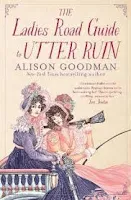
Review: The Ladies Road Guide to Utter Ruin by Alison Goodman


The Ladies Road Guide to Utter Ruin by Alison Goodman


This is the second in Goodman’s “Ill-Mannered Ladies” series, which follows my new favourite twin sisters Lady Augusta (Gus) and Lady Julia Colebrook. I enjoyed the first in the series so much that I pre-ordered this and read it as soon as it was released. The Colebrook twins are fabulous - unmarried, unapologetic, unrelentingly curious and courageous as anyone could hope to be. In this book, the sisters find themselves helping fugitive Lord Evan and his sister, by saving the sister from the clutches of their eldest brother and trying to clear Lord Evan's name of the murder he has been convicted of.  


I actually think I preferred this second instalment to the first. It is so entertaining - Sherlock Holmes meets righteous feminist indignation. I think what improved this story for me was that rather than focusing on several mysteries, it followed the one throughout. What really makes this such an entertaining book is the relationship between Gus and Julia. They are so different, and yet so loyal to one another. They can read each other's minds and yet at times are so exasperating to one another.  I loved them in the first book (The Benevolent Society of Ill-Mannered Ladies), and I loved them even more here. They feel like the kind of women you might want to write old-fashioned letters to and would find highly intelligent and entertaining correspondents. 


And the romance, sigh. Gus continues her slow-burning romance with Lord Evan, who remains on the run from the law. Julia starts her own romance with a bow-street runner, a more subtle romance than that of Gud and Lord Evan, but obviously still deeply felt. What is great about this series is that despite Gus and Julia having romantic interests in the story, they remain committed to what I would call social injustice and the restrictions that society places upon them due to their age and gender.  


I highly recommend this series, written by an Australian author. Start with the The Benevolent Society of Ill-Mannered Ladies and know that it will get even better in The Ladies Road Guide to Utter Ruin. 


Review: Death of a Foreign Gentleman by Steven Carroll


Death of a Foreign Gentleman by Steven Carroll 


Kobo reviewed my reading habits and suggested this to me as a book that I might enjoy. Seeing that it was by an Australia author, was literary crime fiction in an historical setting, I agreed that it looked right up my alley, so I purchased it on a whim (well done Kobo). 


The story is set in post WWII England (1947 specifically). The story begins with the death of Martin Friedrich, a renowned German philosopher and former Nazi Party member, who is hit killed by a speeding car while cycling to deliver a lecture at Cambridge University. Detective Sergeant Stephen Minter, an Austrian-born Cockney Jew whose parents were interned during the war, is assigned to investigate the case. 


Minter starts investigating, looking into Friedrich's life and uncovering unsavoury truths about the man - his past as a Nazi supporter, his arrogance and selfishness, and his dishonourable treatment of the women that he tricks into his life until they have served their purpose for him. The story oscillates between the different characters, slowly drawing together the threads of their individual narratives to reach the culmination where the truth behind Freidrich's accident is exposed.  


One of the most striking aspects of the book for me was how meaning emerged from a series of coincidences and randomness, and not from a carefully constructed plan or motives. Usually, crime fiction reveals an intentional plot toward some criminal end. Carroll gives us a piece of crime fiction involving chance events. I think was deliberate - to show that cause and effect isn't always a straight line. This is relevant to the post-war world the story is set in, where the characters are left a little bereft with the world and the ways of life that they once believed they knew having been destroyed. 


Maybe what I am trying to say is that Carroll seems less interested in who killed Friedrich, and more in what the aftermath of his death exposes in the lives of the people around him. For example, their grief following his death, their grief following the way, their dislocation from their homes (for some) and family (for others). Perhaps he is using Friedrich's death and its aftermath almost as a metaphor for the war and its aftermath. 


It is definitely a very thoughtful novel, and I recommend it - even if I couldn't honestly say that I loved it. 

Review: Unfinished Business by Shankari Chandran


Unfinished Business by Shankari Chandran 


Shankari Chandran first came to my knowledge when she won the 2023 Mile Franklin Literary Award with her novel Chai Time at Cinnamon Gardens. While that novel remains on my wish list, I picked up Unfinished Business because I will be seeing her speak about this book at the SWF (with Ian Rankin). 


The book itself is a political thriller set against the backdrop of Sri Lanka's civil war. The novel opens in 2009 with the assassination of Ameena Fernando, a prominent journalist known for her fearless reporting. In response, the CIA dispatches agent Ellie Harper to investigate, but with instructions only to do the bare minimum of an investigation so that the US can look as though it is contributing - without actually contributing in any meaningful way. 


The narrative moves back and forth between 2005 and 2009. In 2005, Ellie was part of a failed mission to Sri Lanka that haunts her, along with her failed relationship with Sathyan - who it turns out was Ameena fiancé at the time of her assassination. This was a bit of a convenient coincidence for my liking, and I think put me off a little from the story from the very beginning. 

Driven in part by her desire to make up the past, Ellie dives into the investigation in earnest and uncovers a web of espionage and foreign intervention in other nations. Chandran is making a point of drawing attention a wide range of social, political and human rights issues. The persecution of the Tamil population. Political corruption. Perhaps most importantly the ongoing neo-colonial benevolence where foreign intervention is dressed up as benevolent assistance of the 'we know better' variety but ultimately serves the interests of the intervening country. 


While I wanted to really enjoy this novel and I don't want to understate how important the themes of the novel undoubtedly are, they often took precedence over character development and plot, making the story feel more like a vehicle for commentary than the immersive narrative experience I prefer. 


Review: Green Dot by Madeleine Gray


Green Dot by Madeleine Gray


It was almost by chance I came to this. A colleague mentioned that she was reading it, and within a week I found it on sale and thought "why not"? It wasn't until a few weeks later that I realised I was going to see Madeleine Gray at the SWF and so it jumped up the priority list. 


I actually enjoyed this book far more than I expected it. I think we can call it contemporary romance, and I won't lie, one of the things that I was particularly drawn to is that it is set in my city and events occur near where I work. I could really visualise the characters in the actual places that are within my own experience. When Gray describes the workers entering their place of work - how they look, how it feels to be one of them - it connected with my own personal experience. Even just the way Gray describes how the office works - the siloing of colleague groups, the awkward interactions, the importance of finding some you can connect with and send those snarky messages to when required. Gray nailed it. 


The novel follows Hera, a 24-year-old Australian navigating the disillusionment of post-university life. She has finished her degrees, still lives with her father and despite feeling completely disconnected from herself and those around her, she concludes its time for her to do something to move her life forward. She begins working as an online comment moderator and finds herself drawn into an intense affair with Arthur, her older, married colleague. Despite identifying as a lesbian, Hera becomes infatuated with Arthur, finding in him a source of excitement and escape from her mundane routine. Their relationship, largely sustained through digital communication (hence the green dot connection - that good old green dot on Teams) begins to consume Hera's life.


Hera's voice was one of the key strengths of the novel for me. Her voice is bold and unique - she isn't afraid to engage with her own inner thoughts and self. She recognises that her actions aren't acceptable, that they do damage to her, to Arthur, to his family and to those that love and support her. But despite knowing it's wrong she isn't afraid to pursue her desires knowingly. She is chronically anxious about what people think about her but handles this by making every attempt to seem overly confident and extroverted. I think this is a fairly authentic depiction of how some people deal with their own anxiety. 


It also added a welcome element that the story was told from the perspective of Hera looking back on her affair with Arthur - we know where it all ends, but it doesn't impact the journey. I would say that even though Hera was the leading lady, as someone much closer in age and experience to the 'older man' I couldn't help but reflect on the experience of him and his family, something that isn't really touched on in the book. The duplicity that can sneak into marriage. The desire to be the centre of someone else's world and what people will do when that feeling fades in their own relationship. The heartbreak and betrayal his wife must have felt. This definitely wasn't the point of the story - just where perhaps my own age led my thoughts and reflections.  


In short - this was a compulsive read, and I highly recommend it. 

Vale Kerry Greenwood


Vale Kerry Greenwood (1954 - 2025)


It was with a very heavy heart that I read yesterday about the passing of Kerry Greenwood. Her Phryne Fisher books have been some of my favourite books since I started reading them. I’ve read and re-read all of them, and many of the Corinna Chapman books too. I love Phryne Fisher. She is bold and an unapologetically feminist character: intelligent, independent, sensual, and always deeply committed to justice. Watching her come to life on screen in Miss Fisher’s Murder Mysteries and Miss Fisher and the Crypt of Tears only deepened my love for her, and I recommend the books and the series to everyone I can.


Kerry Greenwood herself was someone I always admired. I felt that we had things in common - both of us lawyers, both legal aid lawyers, both drawn to that work because of a commitment to social justice. She struck me as so authentic and grounded. Years ago, I emailed her (I found her address in the back of one of her books!) to ask if I could interview her for a blog I was guest writing for. To my amazement, she replied - she was gracious, generous, and kind to someone she'd never met. The interview has long since disappeared into the internet ether (although here is my post about it), but I’ve never forgotten her warmth, humour, and willingness to engage.


She gave so much. Vale, Kerry. And thank you.


Some links:

Wit, charm and heart: novelist Kerry Greenwood, creator of Phryne Fisher, was a true original

Kerry Greenwood, Australian author of Phryne Fisher murder mysteries, dies aged 70 | Australia news | The Guardian

Kerry Greenwood: Australian author remembered - ABC listen

Review: Earthly Delights by Kerry Greenwood (Australian)

Kerry Greenwood's Earthly Delights was an easy and enjoyable read.

Earthly Delights is a detective story. The protagonist Corinna Chapman is a straightforward woman who runs her own successful bakery. Like a lot of detective stories, there are a series of mysteries to be solved. Who is the stalker who is threatening all the owners of Corinna's unit block? Is Corinna's new bloke Daniel more than he seems? Why has a junkie ended up dead in Corinna's back yard?

Whilst I can tell you the main mysteries that Corinna was faced with in Earthly Delights, I must admit that for me, months later, the plot is pretty forgettable.

Perhaps some of the plot was lost in amoungst the larger-than-life characters. In Earthly Delights we have a baker, a dominatrix, a Wiccan, a professor, an old married couple, a social worker helping the homeless, computer geeks and stupid young girls. Although this provided great variety, it still struck me as a bit too far-fetched that you find so many unusual individuals all living within a stone's throw of each other and all being involved in one way or another with each other. What else struck me about the characters is that even though each appeared so unique on the surface, somehow or other they all feel so cliched. I felt like I could just tick of the cliches as I went, the hippy witch, the Gen Y girls obsessed with their phones and clothes, the handsome do gooder and so on and so forth.

What I appreciated even less than the cliched characters... were the cats. Corinna Chapman is a cat person. And I am not. I heard far too much about her 3(?) cats and what they got up to.

What I did appreciate was that Greenwood was certainly trying to make a point about drug use and homelessness in Australian society, and how people who live with these issues are viewed by the broader population. As someone who works with people like this, I could identify to a certain extent with the way in which those people were portrayed. Greenwood was able to make her point that sometimes people fall into situations that they can't get themselves out of, and sometimes (only sometimes mind you) some help and compassion can help those people make some positive change in their lives.

Earthly Delights is a harmless and enjoyable read. Fun read... but nothing special. I suppose it didn't help that I read it straight after having read The No. 1 Ladies Detective Agency by Alexander McCall Smith. They were, despite their different settings, similar in terms of having a strong female protagonist with a variety of mysteries to solve, and her own personal history to come to terms with. And yet The No. 1 Ladies Detective Agency delivered this in a unique manner without any cliches. And, at heart, I am still a Phryne Fisher girl when it comes to Kerry Greenwood.


5.5 / 8
Enjoyable. I would recommend it if you are looking for an easy read to fill some time. 


Do you ever feel that your feelings about a certain book is affected by the book you read before it?
  I would be interested to hear when it has happened to you and how you felt the book effected your reading of the following one. 


Originally posted 20 November 2012

Review: Diamond Dove by Adrian Hyland (Australian)

Adrian Hyland's Diamond Dove came to me as a highly recommended book from some other bloggers. I also listened to a fascinating interview with Adrian Hyland on the ABC Radio National Book Show, where Hyland was interviewed about the sequel to Diamond Dove, Gunshot Road, and also spoke about his 10 year experience living and working with remote Aboriginal communities in northern Australia (click here to listen to the interview).

The books protagonist, Emily Tempest, was born to a white father and Aboriginal mother. Although she identifies as Aboriginal, she has always moved freely between the communities and has never been quite sure of where she belongs.

The book begins with her return to Moonlight Downs, the property on which she grew up to which her Clan has been awarded Native Title rights. Her return, however, is not smooth and she soon finds herself embroiled in an investigation when one of the elders, also her old friend, is found murdered and a mentally unstable Aboriginal man named Blakie is blamed for the murder. Initially, Emily sets out to help the police capture Blakie who disappears after the murder. Instead, what she uncovers are a series of strange events and occurrences that lead her to think that Blake may not be responsible for the murder at all. So follows the story of Emily's adventures as she tries to solve the crime and come to terms with her own identity in the process.

The story in Diamond Dove had a lot of promise, but sadly, for me, it just wasn't realised. In Diamond Dove, we see the clash of traditional customs and beliefs with the attraction of larger more urban communities. Hyland also uses the story to explore the practical side of native title land rights and what it means for the traditional custodians and white owners of the land.

My complaint is that the plot itself moved too slowly and lacked a sufficient amount of tension that would have been fitting for what is essentially a work of detective fiction. Perhaps Hyland was trying to mirror the pace of life in the outback for these isolated communities but, in the end, I was willing the book to pick up pace. I also found the characterisation somewhat lacking. I wanted the characters to be more fully formed and a little deeper than they were.

Although the traditions of detective fiction are observed here, I did appreciate the uniqueness that the outback setting brought to the story.


5 / 8
Good and worth reading if you have the opportunity, but there's no need to prioritise it.


Do you appreciate it when an author uses the conventions of a traditional genre, but sets their story in a more unique or unusual time or place?

Also, let me know what you thought of this book if you have read it. I would be very interested to hear your view on Hyland's depiction of this Aboriginal community.


Originally posted 11 December 2011 Page Turners


Review: The Black Russian by Lenny Bartulin

I first heard of Lenny Bartulin's The Black Russian, when it was shortlisted for the 2010 Ned Kelly Award for crime writing. After leaving a comment on one of Bernadette's blogs (see Reactions to Reading and Fair Dinkum Crime) expressing my eagerness to read the book, she kindly sent it to me to read. So, a big thank you to Bernadette for her kindness. Please take some time to have a look at her blogs.

Crime fiction is a greatly underrated genre, and so recently I have been deliberately making and effort to explore it further.

Lenny Bartulin's The Black Russian ticked a lot of boxes for me. It was crime fiction, it was Australian, it was set in Sydney (my hometown), it had a reputation for being funny and, as a bonus, its protagonist was a second-hand bookseller.

It had all the makings of a great read, and Bartulin delivered.

"After yet another slow week at the cash register, Susko Books - that fine purveyor of second-hand literature - is facing financial ruin. Jack Susko heads to a gallery in Woollahra to scrape up some funds with the sale of an old art catalogue. With his characteristic panache and exquisite timing, he arrives just as De Groot Galleries is being done over by masked thieves. Along with a mysterious object from the safe, the robbers seize a valuable first edition from Jack's bag, too.

The owner of the gallery refuses to call the cops, and Jack is offered a sizeable sum to keep silent. But when de Groot arrives at the bookshop with his heavy to renege on the deal, all bets are off. With an ease that almost constitutes a gift, Jack Susko finds himself at the centre of a world full of duplicity, lies and art theft."


Although this might sound a little shallow, what I enjoyed most about this book was that it was based in Sydney, and much of the action took place in areas I am very familiar with. I liked seeing those areas depicted in fiction; roads I drive along several times a week, buses I regularly catch and at one stage, a street my parents in law actually live on. I think Bartulin really captured what Sydney feels like - the weather, the streets, the people. He is able to capture the different atmospheres and lifestyles of Woollahra, the city and the western suburbs for example.

In fact, The Black Russian has a distinctly Australian flavour, expressed in the accuracy of the depiction of the setting as well as the dry Australian humour in Bartulin's writing. 

The characters were perfectly formed stereotypes. There was the money hungry art gallery owner, the evil and morally repugnant crime boss, the femme fatale and of course the cynical and frustrated small business owner. Fortunately, Bartulin was a skilled enough writer to prevent the stereotypes from becoming cartoonish caricatures - thus maintaining the humour that they each provide.

Perhaps another risk Bartulin took was with the entirely implausible plot, but rather than distracting the reader with its implausibility Bartulin provides comedy, larger than life characters, accurate and atmospheric setting and witty one-liners to ensure that the reader sees past the implausibility and becomes drawn into the story.

I would even go so far as to say that the implausibility of it is all is almost part of the point of this book. Bartulin uses the larger than life characters and outlandish plot to poke fun at Sydney's 'try-hard' preoccupation with art, culture and money. 

Although this is a comedy, it is primarily a piece of crime fiction. Scribe Publications, the publisher, has quotes on its website comparing Bartulin's writing to Raymond Chandler and Ian Flemming. I haven't read Ian Flemming, but I think that a direct comparison to Raymond Chandler's work is perhaps taking things a bit far.

There is certainly the influence of the often talked about hard-boiled style of crime fiction writing in Bartulins writing, most clearly in the dialogue of Jack Susko. This was the books main weakness for me, but a weakness I see in a lot of hard-boiled style pieces of crime fiction (and so probably more a question of personal preference than weakness). A lot of the time Jack Susko's sarcastic sense of humour is very funny, but at other times it felt false and unauthentic. Consider these exchanges in the early part of the book between Jack Susko and the two thieves who are holding him at gun point.

In the first exchange, Jack Susko is being duct taped to a chair by one of the thieves:
"'Nice mask,' said Jack. 
Shane ignored him, concentrated on winding the tape.
'Why didn't you wear the cape?'
'Lone Ranger doesn't wear a cape.'
'You mean you're not the Scarlet Pimpernell?'"
The second exchange takes place as the second thief goes through Jack Susko's bag and pulls out his copy of a valuable first edition Ian Flemming book:
"Walter picked up Jack's bag from the floor. He lifted the flap and had a good look inside. He pulled out a package and waved it around. 'What's this then?'
'A bomb,' said Jack."
Maybe it's the criminal solicitor in me, but I can't suspend my sense of reality quite enough to believe that this is how any person would react when being held up and robbed at gun point, I don't care how financially unstable they are.

Ultimately, The Black Russian is an incredibly humorous book. It is the second in a series of three books, A Deadly Business, The Black Russian and De Luxe. Although I hadn't read the first book in the series this didn't affect in any way my understanding or enjoyment of this one.

You could read this book if you were looking for a witty example of modern-day crime fiction with a good dose of black humour. It is also a good book for a person who is interested in reading an accurate depiction of the people, the life and the atmosphere of the Sydney I know and love.


 6 / 8
Really enjoyable and well written. I would recommend it.

Have you ever read a book set exactly where you live and in the time that you live? What did you think of the depiction of your city?


Originally posted 9 November 2011 Page Turners

The Sunken Road by Gary Disher


Although I abandoned this book before I finished it, I still enjoyed it and intend to revisit at another time. I picked it up because I intended to go and see a Sydney Writers Festival event at which he was speaking (just as an aside, I was so busy at work that I actually forgot that I had rsvp’d to attend until the following day, so in the end I never made it to the event).

When I first started reading it, I was thoroughly impressed. This is not your average novel. The writing is perfect. It captured the feeling of the Australian farming countryside so well you feel as though you are there, on the land, in the heat, with the characters.

What I found most amazing about the book was the way in which it was written – not chronologically – but in topics like “The Beach” or “Moving House” (this was a library book which I no longer have with me so don’t hold me to the accuracy of those examples).

What then unfolds are glimpses of the life of the main character, Anna Tolley. We see her progress through each stage of her life in each of the chapters, each time gaining a new insight into her life. No doubt that by the end of these books, the glimpses we see throughout the book come together to form a full impression of the character of Anna Tolley.

This is one of the most unique books I have read in terms of its structure, and I admired Disher’s obvious talent.

Why did I abandon it? I think for two reasons.

The first was that I was beginning to find it a little bit repetitive. Not in the sense that the same material was repeated over and over again (it isn’t). Only in the sense that I felt as though I was seeing her entire development over and over again. This isn’t necessarily a bad thing at all – and leads me to the second, and purely personal, reason I abandoned it. At the time I commenced the book I was extremely overworked and dealing with some very difficult situations at work. A literary novel just wasn’t what I needed at the time. I needed a book that required no thought, that wasn’t challenging but was fun and easy to read and escape into so escape my own miserable existence (ok, I’m exaggerating for effect there, but I was overworked). So, I got stuck into the Northern Lights Trilogy (Phillip Pullman) instead.

Although I abandoned it, it was beautifully written and felt very unique and is definitely a book that I will revisit in the future.

Originally posted Page Turners 5 July 2011

A Child's Book of True Crime by Chloe Hooper

I really don't know what to make of Chloe Hooper's A Child's Book of True Crime.

It came to me as a recommendation from someone that I really trust but this book was really quite dark and creepy, which stopped me from really enjoying the story.

The plot is centred on Kate Byrne, a young primary school teacher who commences an affair with a parent of one her favourite students. Her lover's wife, Veronica, has just written a true crime novel about the murder of a young girl, Ellie Siddell, who was murdered by her own lover's wife when she discovered their affair.

The novel is written from the perspective of Kate, who appears to become increasingly caught up in some paranoid delusion in which she believes that she will share the same fate as Ellie Siddell. In fact, some of the book is Kate's own reimagining of Ellie Siddell's murder in the form of a children's book, with the story presented through the eyes of a community of native animals. Even this story differs from what we learn are the real facts known about the murder, and it differs in a way that suits what Kate would have us believe about the murdered girl.

Kate is an unlikeable character and an untrustworthy narrator. Is her life in danger or is it in her head? I still don't feel as though I know the answer.

Hooper herself is clearly an extremely talented writer. There are so many themes that are cleverly woven in amongst Kate paranoid musings. She provides us with some really interesting, and no doubt well-researched, insights into the minds of children. She also explores the dynamics of a relationship between an older married man and a young female. She also gives us an insight into the mind of someone who is arguably mentally ill.

It was undoubtedly a unique novel. I don't feel as though I have read anything like it before, and I doubt that I will ever read anything like it again.

But A Child's Book of True Crime didn't achieve anything in particular. I was left wanting, thinking to myself "yeah, and….." Hooper delved so deep into the character that there was not sufficient plot to balance with the intense characterisation.

I was left feeling unsatisfied and disturbed at the end of this book. If this is what Hooper was setting out to achieve, then she did it successfully. If there was some deeper purpose to this book (and it reads as though there should be), then it was lost on me.

This book will not receive a rating because I can't quite place my feelings about it.


Please let me know what you thought of this book if you have read it. Did you get it? Was there something more that I am missing or is this simply the musings of a woman slowly losing her mind? If it is, why is that so unsatisfying? 

Originally posted 14 June 2011 Page Turners