Showing posts with label Science Fiction / Fantasy. Show all posts

Review: The Host by Stephenie Meyer


Let me set the scene. Earth has been slowly and insidiously invaded by an alien species, the Parasites, that have been secretly inserting themselves into the bodies of human hosts so successfully that the invasion of Earth is almost over by the time it's discovered. Pockets of human resistence exist, but are ineffective against the scale of the parasitic invasion. Once a Parasite is inserted into its host, the host's human essense is irredeemably destroyed, allowing the Parasite to live independently in the human body, accessing the body's processes and in some ways it memories - its likes and dislikes and feelings. The Parasites have been travelling the Universe, moving from host species to host species. Despite their way of living and methods of colonisation, they claim to be a non-violent non-confrontational species, that looks down on humans for their savage way of existence. 


The Host is the story of Wanderer, a centuries old Parasite that has been inserted into the host body of Melanie Stryder, a recently caught member of the human resistence. The only issue is, Melanie's consciousness still remains inside her body, co-existing and in some ways resisting Wanderer's possession of her body. Wanderer and Melanie must live together to achieve their common goal - to find Melanie's younger brother Jamie and partner Jared, who she left behind when caught by the Parasites. 


The novel is science fiction, but would easily work for people who have little interest in science fiction. The focus is far more on the human elements of the story. Melanie seeks to control her own body, while Wanderer forms relationships on her own terms with the humans that she meets. She wants to support the humans she comes to love but is horrified and repelled by their capacity for violence and their desire to destroy her own kind. Wanderer is incapable of viewing her own species invasion of Earth and destruction of human in the same terms as she sees the human resistenace to this invasion. On an even more personal level, Melanie desires nothing more than than to love Jared again, while Wanderer experiences the strength of those feelings while forming her own romantic connection. 


This was a re-read for me and I still enjoyed it. It isn't high literary fiction, or even particularly well written. But it is an easily accesible and interesting gateway into the world of science fiction that will work well for many people. I enjoy this book, and it will always be something for me to return to when I need something readable and enjoyable to keep me entertained.


3/5: It was an enjoyable read.


Review: Revisiting The Chrysalids by John Wyndham


"Watch thou for the Mutant; Keep pure the stock of the Lord."

I first reviewed The Chrysalids in 2011 and declared it one of my favourite books of all time and honestly, nothing has changed. I’ve now read it multiple times, and each time I pick it up I’m gripped all over again. It’s one of those rare books that never loses its power for me. Every time I read it I find myself holding my breath in the same places, turning the pages fast and completely absorbed. 


Written in 1955, The Chrysalids is a post-apocalyptic novel set in a future that feels alarmingly possible. Society has collapsed (we assume due to nuclear disaster), and the survivors have retreated into a fundamentalist worldview where 'purity' is everything. It’s a rigid, brutal world in which any deviation from the norm (whether animal, plant, or person) caused by the nuclear disaster is hunted out and destroyed.


The protagonist and narrator, David, is a quiet boy growing up in this strict religious farming community. But he’s also harbouring a dangerous secret: he has telepathic powers. There are others like him who can communicate silently across great distances and who realise that they must band together for survival and hide what they are. But of course, that only lasts so long. The tension builds as David and the others are forced to run, ultimately placing all their hopes in a mysterious, advanced society from a far-away land called Sealand (which is very obviously meant to be New Zealand, I love that).


Reading it again, what continues to impress me is just how modern this book still feels. Wyndham might be writing from the 1950s, but his insights into bigotry, conformity, fear and power could be written today. The Chrysalids is a novel about intolerance, and I don't just mean the overt kind. Importantly, it's about subtle, systemic, internalised intolerance. It asks huge questions in a deceptively simple way: What is 'normal' and who gets to decide? What happens when you fall outside of that?


What stood out more on this re-read is just how unsettling some of the ethical questions are. Wyndham doesn’t make it easy for us to pick sides. The religious fundamentalists are clearly oppressive, but the Sealanders, with all their superiority and cool detachment, are not necessarily the comforting saviours they appear to be. There’s a moment near the end when one of the Sealand women explains, without emotion, why those who can't communicate telepathically will inevitably be left behind. And you realise that every society, no matter how advanced it considers itself to be, has its own intolerances and dogma.


That’s what I love about this book. It’s not just thrilling and absorbing, it also leaves you thinking long after you’ve put it down. I keep returning to the idea that prejudice never looks the same twice. It mutates, just like the people and animals in the story.


This time around, I couldn’t help but see the parallels with today’s politics, particularly in the US where groups like Trump supporters rail against things like "liberal cancel culture” and preach about free speech and traditional values, while simultaneously banning books, suppressing education, and attacking anyone who doesn’t conform to their version of what’s 'normal'. It’s the same pattern Wyndham explores - a fear of difference and change disguised as moral certainty.


And we’ve seen shades of it here in Australia too. I reflect on the national debate around the Voice referendum and the way some political leaders painted the proposal as divisive while encouraging fear, misinformation and a rigid definition of unity that excluded actual inclusion. It’s not hard to draw a line from that kind of rhetoric back to Waknuk. In both cases, it’s about controlling the narrative of what belongs, and what doesn’t.


Wyndham reminds us that intolerance often wears the mask of righteousness. Whether it’s religious purity in Waknuk and the US or political dogma and national identity debates in Australia and the US, the urge to define and destroy the 'other' is disturbingly persistent.


I know I’ve said it before, but I’ll say it again. The Chrysalids is easily my favourite Wyndham. It's one of my all-time favourite books full stop. And somehow, it keeps getting better and more relevant every time I read it.

Babel: Or the Necessity Of Violence by Rebecca F Kuang


I loved Babel: Or the Necessity Of Violence but it dealt with so many important issues in such a meaningful way that I have felt a little unsure about whether I can really capture it in a review.


I came to it because I have been trying to read the Longlisted and Shortlisted books for the Booker Prize 2025, and Babel: Or the Necessity Of Violence was high on my priority list after reading Yellowface by Rebecca F Kuang last year and appreciating the way that she explored cultural appropriation. 


In Babel historical fiction meets fantasy fiction - set in an alternate 19th-century England, where the power of empire is fuelled by the magic of translation. This is literal - with silver bars that harness the lost meaning between words in different languages to produce extraordinary effects. Placed in a carriage they can increase the speed and comfort of the drive. Placed on a ship they can improve the quality of the journey and increase speed. The magic of the silver bars is created through the work of Babel’s translators, who inscribe them with paired words from different languages, capturing the untranslatable gaps in meaning to unleash powerful effects that only those fluent in both languages can activate.


The story centres on Robin Swift, a Chinese orphan brought to England, who is trained at Oxford’s Royal Institute of Translation (Babel), where linguistic magic enhances colonial domination. Robin and his group of close friends, are treated as second class citizens even when their skills are required by the empire, slowly become aware to the moral contradictions of the system that saved then in many cases from poverty, but at the same time has enslaved them through dependence. They are each faced with a decision about whether they continue to serve the British Empire or fight it.  


Although one of the books main themes was undoubtedly the power of language and how it can be used as a tool of colonialism and imperial control, for me what forcefully struck me was the question contained in the title - the necessity of violence. Can meaningful change ever come without violence?  


Is violence necessary to create social change?


For me, this is the question that stuck with me the most throughout the book, and something that the characters are increasingly forced to reckon with. Robin and his friends all try different ways to push back against the system the Empire has created. They try working within it and consider how they can contribute to its reform before eventually turning to more drastic action. The book made me reflect on what I suppose is an age old question in the modern world - we can argue our position against injustice, call for change, try the path of logic and advocacy, but if the people who have the power to create won't listen because their power is derived from the system itself - then is there any choice but violence? 

Kuang didn't glorify violence in Babel, but she also didn’t shy away from the reality that history has rarely changed without it. It made me reflect on the women's suffrage movement, where women turned to arson, bombings, and hunger strikes after years of peaceful protest were ignored, and they were succeeded. During the industrial revolution violent strikes, riots, and worker uprisings were crucial in achieving improved working conditions through legal reform. I think history shows that in most cases change does require violence and relies on people willing to sacrifice themselves to bring it about. 


Friendships and family


Another theme throughout the novel that I continue to reflect on is that of friendship and how the characters rely on it in the face of oppression to give them hope and purpose. Robin and each of his friends are from different parts of the world and as they enter the world of Oxford they increasingly feel the contradictions in their day to day to day lives. At Oxford, they are treated as second-class citizens. The women are unable to live on campus or attend events without pretending to be men, and the men are attacked and ridiculed for the colour of their skin. 


This is where the contradiction lies. On the one hand, they are clear that their social standing is not that of other students at Oxford while on the other hand the Empire requires their skills to maintain and extend its power. On the other hand, they are crucial to the empire’s power. This forces them to grapple with their place in a society that values their skills but not their humanity. 


We are also able to see these same contradictions played out in Robin's personal life. As a child he was removed from his family and taken to England by a man who valued his skill and ability with languages. It was clear that he viewed Robin's 'success' as a personal triumph because he believes that he has raised Robin to overcome the inferior traits he associates with Chinese people. He sees Robin as an exception arising from the positive influence of the British Empire and is blind to any systemic oppression. He sees a successful experiment that has brought glory to the Empire, not his ward's humanity. 


But it was so inspiring the way that sharing many of these experiences brought the friends together and gave them the strength to cope with the challenges that were thrown their way. However, while Robin and two of his friends were immigrants to England, their third friend, a white British student, doesn’t fully understand the weight of their struggle, and this difference strains their friendship. 


This made me reflect on my own privileged position in Australian society. As someone with privilege, I recognise that disadvantaged cohorts and individuals often have lived experiences and insights about issues that I cannot fully grasp. That means that I need to try to listen and accept their truth without filtering them through the lens of my own privilege. This is something that we all need to do better with and is certainly the case for the friendships in Babel. 


A book that makes you reflect in these ways is well worth the read, and this comes highly recommended from me. 

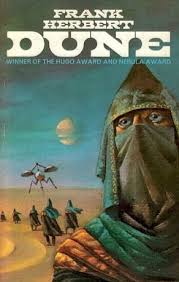
Review: Dune by Frank Herbert

I have always wanted to read Dune. I have a weakness for good old fashioned science fiction, and I had recently read some Asimov books that I had really enjoyed. I also remember as a child listening to my father talking about how much he enjoyed reading Dune.

So, when it came time to choose my next book I thought that the time had finally come for me to pick it up and give it a read.

Dune is a difficult book to summarise but I will do my best.

The story is full of political intrigue. The Atreides family are awarded a lucrative contact mining the planet Arrakis for melange, a drug that also happens to be the most valuable resource in the universe. The contract had previously been held by the Harkonnes family who also happen to be Atreides family enemies.

With the support of the Imperial Majesty, the Harkonnes rebel against the loss of their valuable contract. Duke Leto Atreides is killed and his concubine Jessica and their son Paul escape into the dessert on the planet Arrakis where they are supported by the native population called Fremen.

The Fremans see Paul as someone sprung out of a legend. Paul takes on the mantle he was destined to wear, that of Muad- Dib, essentially the Messiah of the Fremans. His goal is to take back Arrakis from the Harkonnes and turn it into an ecologically sustainable planet.  In the end he gets even more.

Sigh.

I was really ready to enjoy this book and maybe that was the problem.

It had the makings of a great book.

The story is epic. It is set in a future imperial space empire. The planet is populated by giant worms that consume everything in their path. There is political intrigue. There is romance. There is love.

And yet…. I don’t know.

I just got lost. The books focus seems to lean toward philosophy and religion. It takes itself very seriously. So seriously in fact that I think the story just got lost in amoungst all the religious and philosophical rhetoric. By the end of the book I didn’t really understand Paul’s motivations. I didn’t enjoy reading all of Jessica’s inner reflections. I had lost sight of what everyone was trying to achieve in amoungst all their ponderings and discussions and…… snore.

I might be out on a limb. I know a lot of people love this book and I have obviously missed something. I even wish that I could think of something more interesting to say about it. There are probably some significant themes in the books that I could identify (Climate change? Cultural respect?) I just can’t really even bring myself to think about it that much.

I am glad that I finally read it, I can honestly say that. I only wish that the story had grabbed my interest a little more. 

 4 / 8 stars

Alright, but I wouldn't recommend it.


Originally posted 25 June 2015 Page Turners

Review: Blind Faith by Ben Elton

He worked in the DegSep Division of NatDat. DegSep was short for Degrees of Separation and it existed in order to establish and catalogue the connections (no matter how tenuous) between every single person, every other person and every single thing that happened. 
~Blind Faith by Ben Elton

The "he" referred to here is Trafford, the protagonist of this comic dystopian novel. Blind Faith is set in a future where the world as we know it has been wiped out by a disastrous flood brought on by mankind's carelessness toward the environment. In its place is a world ravaged by plagues, where only 50% of children survive past their 5th birthday and vaccinations are illegal because they contravene God's Will.

In fact, there is now a single world religion in which the entire population participates with blind faith. In this religion, people are told that they are the embodiment of God and that to respect God they must worship themselves. Privacy is seen as a perversion and everything one does is recorded and shared with everyone else via all forms of social media. People must blog daily and place footage of everything from childbirth to sex to shaving their bikini line on You Tube for everyone else watch. This is a world where it is sinful for women to have natural breasts, g-strings are every day dress and McDonalds is the fanciest restaurant around.

Trafford, a conservative man who wears shorts as long as half way down his thigh, secretly despises the world in which he lives and desires the ability to reason for himself. Blind Faith is the story of Trafford's attempt to reason for himself and share his knowledge with the rest of the population.

Blind Faith is essentially a warning. Firstly, it is a warning against the dangers of climate change. In this future, the earth has been abused to such an extent that is has responded with a devastating flood, that has killed a significant proportion of the world's population, changed the geography of the planet and bought with it ravaging diseases.

Secondly, and what struck a nerve with me, it is a warning against what might come as a result of the increasing fascination with sharing our lives and thoughts via social media (blogging for example!). Elton creates a world where people have become so engrossed with themselves and sharing every minute of their lives that they have come to see themselves as the embodiment of God on earth and therefore deserving of the worship of others.

As I was reading the book, I couldn't help but wonder whether or not this was too much of a leap, a little too unbelievable. I can see the dangers of social media. I don't use twitter, and I don't use Facebook. I don't have an interest in sharing every little thing with every other person who pretends an interest (or even has a real one). If there's something I want to share with someone, I would hope that I could be close enough to that person to share it with them in a more personal way. Yet I found myself wondering as I read the book whether mankind would really take it so far? Scarily though, the more I think about it the more I wonder if it isn't a possibility we should give some thought to. The book has made me wonder why it is that we want to share so many details of our lives in such a public way and what effect this could have on our collective psyche. Already in places like America they allow video cameras in the court room and televise trials. In Australia we see footage on the news of videos people have taken on their mobile phone of incidents they've witnessed where their first response is to pull out their mobile and film it rather than just experiences it or assist in any way. 

I was forcibly reminded of Blind Faith a couple of week ago at the football, when below me in the crowd I witnessed a fight and almost the entire stand around them stand up and pull out their mobile phones to film the fight as if it was entertainment they would laugh over with friends later that night. Could it be that sharing so much about ourselves makes us feel more important than perhaps we should feel? Might we become suspicious of those that don't share their thoughts and actions with others via social media? How far could this go? I don't know the answers to these questions, but Blind Faith certainly raises many of these questions in the reader's mind.

Although some of this might sound serious, Blind Faith is really a comedy. The world of the future is outrageous. Every time I read some newly uncovered aspect this this future world, like Trafford's conservative shorts that reach halfway down his thighs, I found that I had to share it with my partner so that I had someone to laugh with. This outrageousness is, I think, Blind Faith's biggest strength.

Its biggest weakness for me, however, was the way in which Elton delivered his messages. Elton had a definite agenda he wanted to address in relation to the dangers of social media and climate change and as I read the book I felt as though I was being hit over the head with it so to speak. Although it was a funny book, I can think of other works of dystopian fiction dealing with the same issues in a more subtle way.

So, I enjoyed Blind Faith. In fact, the more I think about it, the more I can see that I have got something out of reading it. It's funny and outrageous, although in the end I think that this distracts somewhat from the book's message.


5 / 8 stars
Good and worth reading if you have the opportunity, but there's no need to prioritise it.


Have you ever given any serious thought to the danger that social media might pose to our world in the distant future? How do you think that blogging might contribute to this, if at all?

Originally posted 8 January 2013 Page Turners

Review: The Twelve by Justin Cronin

One of the things I was looking forward to most this year was the release of The Twelve by Justin Cronin. It was worth the wait. I couldn't put it down.

The Twelve felt very different to The Passage. It felt to me to be more of a thriller than a piece of paranormal speculative fiction (or whatever else you might classify it as).

Also, where The Passage seemed to deal more with the experience of the individuals in the aftermath of the virus, The Twelve dealt more with the state of the nation following the release of the virus. We see people spread across the country living in different outposts, attempting to establish themselves in a manner they can sustain in the face of the adversity they now face.

Where some of those new cities are facing their challenges with respect for the human race, there is another city being established and controlled by the 'red-eyes' where this is not the case. The Homeland, as it is called, is run by people who have infected themselves with the virus but have not flipped, and they see themselves controlling the world in conjunction with the virals. In this way, an interesting question is raised in The Twelve: how can the virals sustain themselves when they have almost eaten their entire food source? It's a question I am surprised I never really considered while I was reading The Passage. In The Twelve we see one solution imagined by humans who are willing to betray their own race.

The characters I came to know in The Passage had all gone in their separate directions, and yet I still felt attached to them all. I was invested in their lives and read with bated breath to see what had become of them now.

I do have to say I was rather frustrated that there was so much about The Twelve that I didn't understand.

*SPOILER ALERT* Why didn't the red-eyes flip? Why was Lucius Greer so attached to Amy, was he her familiar? What is this ship they were talking about? How was it that Amy came to be talking to Carter, as if in real life? How is it that Wolgast came back into the story as a viral? Why didn't Alicia flip and who is talking to her at the end of the story? My questions could go on and on. *END SPOILER*

I hope very much that these questions are answered in the third book. If not, I am going to need someone a lot smarter than me to explain it all to me. 

Ultimately, the pace was fast, and I couldn't stop reading. If I were to be honest with myself, I think that a big part of why I couldn't put it down was my commitment to The Passage rather than the contents of this book, but I still loved every minute of it.


7 / 8 
Brilliant, couldn't put it down. Recommend that you buy it. 


So, who else has read The Twelve yet? I am dying to hear what you thought of it after all the anticipation. Were you as confused about a lot of what happened as I was?


Originally posted 30 November 2012

Review: Mockingjay by Suzanne Collins


In Mockingjay, the final instalment of the Hunger Games trilogy, Collins gives us full scale revolution of the Districts of Panem against the Capitol.

Katniss plays an integral role in the revolution, although at first she is not convinced that she wants or is even able to take on this role. She soon realises, however, that her needs are not as great as those of Panem and she takes to her role wholeheartedly. Although the love triangle between Katniss, Gale and Peeta is still explored in Mockingjay, it is the themes of oppression and revolution that play a primary role,

I found the plot in Mockingjay more... messy (for want of a better word) than the plots of The Hunger Games and Catching Fire. It felt a little as though Collins was trying to fit so many parts of the story into the final book that it became a little chaotic.

Having said that, I so admired the way in which Collins portrayed the revolutionary forces and the Capitol that a little chaos in the plot was soon forgotten.

In Mockingjay, Collins doesn't give us a black and white world. The Capitol is not portrayed as always being in the wrong, just as the revolutionary forces are not portrayed as always being in the right. Both the Capitol and the revolutionary forces use the same media indoctrination techniques as each other to takes their messages to the masses. The revolutionary forces create short video clips, essentially advertisements for the revolution, which they broadcast throughout the country.  To do this, the revolutionary forces send camera crews into real battles, people are dressed in dramatic costumes for effect and great thought is given to setting up 'scenes' that best suit the video clips they are creating. These clips are often as manipulative as the Hunger Games themselves were. In fact, the leaders of the revolutionary forces are shown in the end to be just as power hungry as the leaders in the Capitol.

It is clear in Mockingjay that the desire for power can corrupt the best of people who have the best of intentions, regardless of which side of a conflict they are on, and in showing the extremes that the Capitol and the revolutionary forces are willing to go to in order to manipulate and even harm the populace in the name of their cause, Collins gives the conflict a sense of reality.

I did find that Mockingjay was a little slow to get started, and perhaps a little repetitive in the early stages while Katniss was deciding whether she was willing and able to play the part in the revolution that people wished her play. I also thought that Katniss's journey to the Capitol was a little far fetched but then I reminded myself that this was fiction, a YA novel set in a possible future, and so a little bit of implausability could be forgiven.

All the same, there is is something so raw and real about these books that I was unable to put them down. Mockingjay definitely doesn't disappoint as the final instalment in this thrilling trilogy. 


8 / 8
One of the most enjoyable books I have ever read.  Everyone should read it, it is amazing.

What did you think about the final instalment of The Hunger Games trilogy? Did you find it a satisfying end to the story or were you hoping for something different? How realistic did you find Collins portrayal of the social and political revolution that was taking place in Panem? 


Originally posted 1 July 2012 Page Turners

Review: Catching Fire by Suzanne Collins

The Hunger Games largely focused on Katniss, her relationship with Peeta and surviving the Hunger Games. All this of course while also dealing with themes such as individual freedom, oppressive governments, media influence, poverty and social inequality. Catching Fire expands on these latter themes.

The Capitol is not happy with Katniss and Peeta for their show of defiance at the end of the Hunger Games. Uprisings are beginning in some of the Districts, and the Capitol blames this on their act of defiance, which they fear is inspiring other acts of defiance from the Districts. To punish Katniss and warn the people of Panem that defiance will not be tolerated, Katniss and Peeta are again thrown into the Hunger Games, where all of the surviving winners of past games are pitted against one another.

Catching Fire, however, is about more than just the survival of Katniss and Peeta. 

Where Catching Fire really adds to The Hunger Games is the shift from this narrower focus to the broader themes raised by the political situation in Panem; fighting against oppressive governments and bringing hope to the people. In Catching Fire we see the subtle shift in the population – when people stop accepting and start questioning. The government is trying to maintain control of an angry population who have discovered that there’s hope for a better life, as represented by Katniss and her individual act of defiance.

Katniss herself is just as strong and independent a character as she was in The Hunger Games, something I think is hard to come by in YA novels, especially for female characters. The teen angst surrounding her love triangle is still present and is a little teenage for my tastes, but it is a YA novel after all. Nonetheless, Katniss has grown from her experiences in the past. She is more grown up, more cynical and more realistic about the world in which she lives and her role in it. She is strong female character, willing to fight for what she believes in and those that she loves.

Without knowing it, in her final act in the Hunger Games Katniss has come to represent to the people of Panem that spirit of rebelliousness they all feel inside them. In Catching Fire, Katniss becomes swept up in events bigger than herself and bigger even than the Hunger Games and in doing so she begins to question what she can do for the people of Panem.


 8 / 8
One of the best books I have ever read. Everyone should read it - it is totally amazing. I am in love.

Did you think that Catching Fire added to The Hunger Games by building on the themes I mentioned, or do you prefer the love triangle plot between Katniss, Peeta and Gale? 


Originally posted 21 March 2012 Page Turners

Review: The Hunger Games by Suzanne Collins

The Hunger Games is an utterly compelling YA Dystopian novel from author Suzanne Collins.

The book is set in the future, when the world has been largely destroyed by an environmental disaster that has changed the face of the planet forever. More specifically, it is set in what used to be North America, now known as Panem, a country of 12 Districts all ruled by The Capitol. The Capitol is an oppressive government, forcing the people of the Districts in poverty while they consume the bulk of what the Districts produce. In punishment for past uprising by the Districts against The Capitol, The Capitol has given the people of Panem the Hunger Games. But what are these Hunger Games?

"The rules of the Hunger Games are simple. In punishment for the uprising, each of the twelve districts must provide one girl and one boy, called tributes, to participate. The twenty-four tributes will be imprisoned in a vast outdoor arena that could hold anything from a burning desert to a frozen wasteland. Over a period of several weeks, the competitors must fight to the death. The last tribute standing wins."

The Hunger Games is a first person narrative, written from the perspective of a teenage girl by the name of Katniss from District 12, the coal mining District. Katniss and her family live in poverty in the Seam, relying on Katniss’s hunting skills to supplement their meagre diet provided by the Capitol. When Katniss’s younger sister Prim is chosen as District 12’s tribute, Katniss steps up to take her place. She is soon joined by a young man by the name of Peeta, someone to whom she and her family owe their lives.

What follows is the story of Katniss and Peeta’s experiences leading up to, during and following the Hunger Games (that’s not a spoiler – this is the first of a trilogy after all!). A large part of the story that follows deals with the love triangle between Katniss, Peeta and Gale, Katniss’s best friend. Both young men are in love with Katniss and Katniss loves both of them in return, but is unable to determine which she has more genuine feelings for. It is this element of the story that is certainly the most teenage part of the book.

Having said that, although The Hunger Games might be marketed to a young adult audience, this is equally a book for adult readers of all types.

One of the things I was most impressed with was the way in which Collins brings to life her characters and emphasises those personal attributes that should be admired. For what is essentially a plot driven YA novel, she did this incredibly well. There were so many different layers to the various characters which meant as a reader I could connect with each of them in different ways. Collins explores loyalty, courage, morals, family, love and much much more.

But where Suzanne Collins really excelled, and what I think adult readers will appreciate the most, are the themes that run through the book. There are so many adult themes that run through this book that I couldn’t possibly hope to deal with them all. These themes include social inequality, poverty and political hype/power. A lot of these were explored through the contrast between the lives and lifestyles of those in the Capitol and the lives and lifestyles of those in the Districts. The decadence of the first and poverty and starvation in the second.

What resonated most for me was Collins exploration of the power of the media and more specifically, the prevalence of reality television, in today’s society. What are the Hunger Games? It is children killing other children, but more than this, it is entertainment for the masses. To win the Hunger Games Katniss has to kill the other children, but she also has to win over the audience as the producers in charge of the television event manipulate their environment, exercising ultimate control over what happens within the arena and to the contestants. They are not children, they are contestants. It isn’t life or death, it’s entertainment. It isn’t manipulation of viewers and contestants alike, it is ‘reality’. People are so desensitised to violence that they can watch these events without blinking and without questioning.

Clearly our current western society doesn’t stoop to such lows, but in reading The Hunger Games you can’t help but reflect on our own reality and the role that the media plays in our lives. To what extent are we manipulated in the way that the populace in The Hunger Games is manipulated? Why do we allow it? Where will it end for us?

All I can really say is that The Hunger Games is so much more than you might expect. I was completely carried away by this book; I couldn’t put it down during the day and I was dreaming about it at night. It’s a little like a young adult version of Orwell’s 1984. Not as well written, not as complex, but just as clever in its use of the future to explore today’s society.


8 / 8
One of the best books I have ever read. Everyone should read it - it is totally amazing. I am in love.

I would love to know if other people enjoyed it as much as I did? Has anyone been avoiding the series because of the hype and do you think that you could possibly rethink your decision?


Originally posted 11 March 2012 Page Turners

Review: The Midwich Cuckoos by John Wyndham

John Wyndham's The Midwich Cuckoos is another of his eery science fiction classics with universally significant themes.
 
The rural village of Midwich in country England was little known until "Dayout". The entire town becomes enclosed in an invisible dome. Everyone inside the dome falls asleep, and no one outside it can enter or determine what is happening. Just as inexplicably, the dome is soon lifted and the inhabitants come to.

Everything seems to go back to normal fairly quickly, but one by one each of the women of childbearing age and ability find themselves pregnant. Each bears a child, but these children are not what they seem. It soon becomes clear to the villagers that the Children have an ability to make people do their bidding, as well as a very special connection between each other. Eventually the town must make a choice, do they save themselves or do they save the world?

There was much to love about this book, although I found it somewhat of an anticlimax compared to his others. I think the reason for this is that the action that is so integral to his other novels takes a back seat to Wyndham's own philosophising on matters such as evolution, race, religion and justice. The story of The Midwich Cuckoos provides the perfect mechanism for exploring these fascinating issues. Are the Children really men or some other species? If they are some other species, is it murder to kill them? Is it murder if they kill people in the village? How do the laws of one species govern the behaviour of another? Is justice about getting even or is there something more to it? If God created all species, did he intend that mankind's supremacy on earth come to an end when he created the Children, is it simply a part of evolution?

Then there is the more overarching question of collectivism vs individualism - should mankind as a whole be prioritised over the lives of some individuals that comprise mankind? How can such decisions be made and by who?

I am not quite sure where to place this in my thinking of the book, but it did occur to me that what Zellaby does at the end of the book reflects to a certain extent what Jesus Christ is said to have done for mankind. Going hand in hand with the question of individualism v collectivism is this idea of self-sacrifice and what role it plays/should play in our lives. How far would be go for others and in what circumstances? This is something that is worth further thought, especially in conjunction with Wyndham's reflections on religion throughout the book. It's something I will reflect more on during a second reading of the book.

There were so many fascinating questions explored, but I felt at times as though Wyndham was pushing his own agenda and views on me through the character of Zellaby, who does most of the philosophising in the book. It was somewhat frustrating, especially when it was mixed with what I consider old-fashioned ideas about religion and more particularly female gender roles.

Don't get me wrong, I loved this book. It was tense when it needed to be; there was danger and mystery. The premise of the story was unique and thought provoking. It only needed a little more action and a little more talk to make it one of my favourites.


6.5 / 8
Really enjoyable and well written. I recommend that you buy it. 

How did you find this one compared to his other books? Does it bother you when you feel like the author is more concerned with getting a message across than getting on with the story? I would also love to know what people thought of the movie adaptations if you have seen them.


Originally posted 15 January 2012 Page Turners

Review: Embassytown by China Mieville

China Mieville’s Embassytown had a lot of potential. Modern day science fiction from a universally admired author with a reputation for producing quality writing and exciting plots. I only wish it could have lived up to my expectations. 

Embassytown’s plot certainly seemed to have potential. It is written from the perspective of Avice Benner, a woman who grew up on the planet of Arieka in a town called Embassytown. She describers herself thus:
“When I was seven years old I left Embassytown. Kissed my shiftparents and siblings goodbye. I returned when I was eleven: married; not rich but with savings and a bit of property; knowing how to fight, how to obey orders, how and when to disobey them; and how to immerse.”
On Arieka, the human colonisers live side by side with the original inhabitants or Hosts, who have a completely different Language system and who are incapable of telling lies. Avice leaves the planet to travel the Immer and is only convinced to return to her home planet when she marries a linguist named Scile who is fascinated by the Hosts.

This is about as far as I got into the book.

I could recognise that there were some interesting ideas in this book, particularly about the use of language. It seems an interesting and rather unique subject matter for a hard science fiction novel.

The issue I had with the book, and ultimately the reason I abandoned it, was because I found it far too conceptually challenging to be enjoyable. I don’t know if I used the correct phrase there, but this is what I mean. There were too many invented words and Mieville provided no explanation for what they referred to.

I don’t mind having to figure things out for myself, but I at least need some descriptive clues to do it, and I felt that these were completely lacking. What it meant was that I spent the entire time I was reading Embassytown trying to figure out what I was reading instead of just enjoying the story.

In the end, I felt as though he left me with no choice but to move on to the next book.


1 / 8
Abandoned

Has anyone else has a disappointing experience with China Mieville? I really want to read something of his that I enjoy, but now I am nervous about exploring his works further for fear of being disappointed again. Any suggestions?

I think it only fair to add that since I attempted to read this book and since I wrote the review of it, I have read a couple of reviews that have made me re-think my initial reaction to Embassytown. This is a book that requires a lot from the reader and I think that perhaps I might not have lived up to my end of the bargain. At the time I read it I was pregnant (still am come to think of it) and this has had a serious effect on my brain capacity (no joke sadly). I was also on holidays, and if there is one thing I want from a holiday read it is that it is easy and fun (ok, two things). 

I am not going to give up on this one entirely. I think I will approach it again when I am in a better frame of mind and am willing to put in the effort that Mieville has asked of me. I hope that this effort will eventually be rewarded. Since this is unlikely to happen any time soon (need to get the baby out first) I might see I have better luck with another of his books.


Originally posted 17 January 2012 Page Turners

Review: The Big Over Easy by Jasper Fforde

ALIEN'S BORING, REPORT SHOWS
An official report confirms what most of us had already suspected; that the alien visitors who arrived unexpectedly on the planet four years ago are not particularly bright, nor interesting. The thirteen page government document describes our interstellar chums as being 'dull' and únable to plan long term'. The report, which has been compiled from citizenship application forms and interview transcripts, paints a picture of a race who are 'prone to put high importance on inconsequential minutiae' and are éasily distracted from important issues'. On an entirely separate note, the aliens were reported to be merging into human society far better than has been expected - the reason for this is unclear. 
~extract from The Owl, 4 June 2001.


Jasper Fforde's The Big Over Easy is the first in his Jack Spratt detective series; a pastiche of nursery rhymes, fairytales and the 'real world' that is hilarious from beginning to end. 

Detective Inspector Jack Spratt is head of the Nursery Crime Division, based at Reading Central Police Station. His job is to investigate all crimes involving nursery rhyme characters, with his new partner.... Mary Mary. Their Easter takes a complicated turn when Humpty Stuyvesant Van Dumpty III is found dead beneath his wall, and they find themselves with one complicated murder to solve.

Not only does DI Jack Spratt have to solve the murder, but he also has to gain a place in the Guild of Detectives, keep his division from closing and hold his arch enemy DI Friedland Chymes at bay as he tried to muscle in on Spratt's investigation. 

Everything is funny about this book; the nursery rhyme characters who don't know that they are nursery rhyme characters, the nursery rhyme and fairy tale jokes and the appearances of the Gingerbread Man, Mrs Hubbard, Rapunzel and Willy Winkie, just to name a few. Mary Mary, well what can I say? She's quite contrary. And Jack Spratt seems to be blend of Jack Spratt and Jack from Jack and the Beanstalk. And that's right, you can expect an appearance from that magic beanstalk.

Fforde is at his best in The Big Over Easy with his plays on words and the fun he has with language in general. Take this extract for example from page 82. It's a discussion between Mary Mary and Tibbit (another member of the Nursery Crime Division):
“…Father liked word games. He was fourteen times world Scrabble champion. When he died, we buried him at Queenzieburn to make use of the triple word score. He spent the greater part of his life campaigning to have respelt those words that look as though they are spelt wrongly but aren't.”
“Such as….?”
“Oh, skiing, vacuum, freest, eczema, gnu, diarrhoea, that sort of thing. He also thought that ‘abbreviation’ was too long for its meaning, that ‘monosyllable’ should have one syllable, ‘dyslexic’ should be renamed ‘O’ and ‘unspeakable’ should be respelt ‘unsfzpxkable.’”
Fforde's cleverness and ingenuity never cease to amaze me. I was a big fan of the Thursday Next series, but I found The Big Over Easy to be a more fun and easier read. Some familiarity with nursery rhymes and fairy tales is essential to really appreciate this book, and thankfully I had enough familiarity with them to really appreciate the jokes. I couldn't stop laughing the whole way through this book.

The Big Over Easy by Jasper Fforde is a funny and satirical piece of detective fiction, and one I recommend to everyone who likes to have a bit of fun with their reading every now and again.


7 / 8
Brilliant, couldn't put it down. Recommend that you buy it.

Have you read this; did you enjoy it as much as the Thursday Next series? Do you have a weakness (like me) for modern day parody's of nursery rhymes and fairy tales? If you do, I recommend The Third Pig Detective Agency by Bob Burke. If you like Jasper Fforde, you are likely to enjoy it.


Originally posted 5 January 2012 Page Turners

Review: The Lord of the Rings by JRR Tolkien, a fantasy masterpiece

The Lord of the Rings by JRR Tolkien is a fantasy classic that has held me in its clutches since the first moment I began reading it.

Now in my late 20's I have read it probably more than I have read any other book, and I am still in awe of how magically fabulous it is. This of course means that reviewing it has proved to be almost impossible because no matter what I write I can't possibly do Tolkien's masterpiece justice.

I am going to go out on a limb and say that the Lord of the Rings is one of the best examples of fantasy fiction that there is. In it, Tolkien has created a perfectly formed alternate history that is as enthralling as it is real. Everything about it; the characters, the setting, the history, the creatures and the language are inescapably real. The details that Tolkien includes in every element of this breathtaking book are mind blowing and Tolkien's skill as a writer renders the story and setting so perfectly that you might as well be in Middle Earth while you are reading it.

Sometimes I feel as though I have lived Frodo's journey over and over again. I can only imagine how he must have felt when Gandalf revealed the truth to him about the true nature of the ring that Bilbo bought back from his travels. In fact, it is this scene that is one of my favourites of the entire book (along with the flight to ford for those of you who are familiar with the book):

"… All we have to decide is what to do with the time that is given to us. And already Frodo, our time is beginning to look black. The enemy is fast becoming very strong. His plans are far from ripe, I think, but they are ripening. The enemy still lacks the one thing to give him strength and knowledge to beat down all resistance, break the last defences, and cover all the lands in a second darkness. He lacks the One Ring".
I get shivers up my spine when I read this even now. It perfectly conveys a sense of ominous foreboding that is present throughout the entire book.

I think that what Tolkien did so effectively in order to create such a realistic fantasy world, is to blend elements of fantasy and reality to the point where they are almost indistinguishable. We know that Hobbits like songs and food, are courageous and courteous and enjoy the simple things in life. Dwarves on the other hand are more concerned with material wealth than anything else. Elves are mysterious and philosophical creatures.

We also know that Hobbits, Dwarves and Elves aren't real, but it is their incredibly human qualities that make this easy to see past and to bring them alive in our minds.

A lot of complaints about The Lord of the Rings centres on its pace, or lack thereof. I agree that the pace changes significantly throughout the book. There are incredibly tense parts of the book (the flight to the ford) and then there are longer more drawn-out parts of the book (for example, when Frodo and Sam are on their final journey across the Morgul Plains to Orodruin to destroy the Ring).

This has never been a problem for me. The book has an epic length because it is an epic tale. Also, the variation in pace seems to accurately reflect what is occurring in the book at that time. The flight to ford goes at a cracking pace because it is perhaps the most dangerous moment in their entire journey. Frodo is about to be captured with the ring and has one chance to get across the river to save it, himself and the rest of Middle Earth. When they are crossing the Morgul Plains, however, they are all alone, tired, dehydrated and at the very end of their journey. These moments for them would have seemed long and drawn out and so the book is long and drawn out in these parts.

I only wish that I could do The Lord of the Rings more justice than what I have done here. Although I don't recommend it to people very often (because whether you enjoy this book is largely going to be a matter of personal taste I think), it is easily one of my favourites of all time.

I can't think of another book that displays such a sense of majesty and admirable human qualities as The Lord of the Rings.


8 / 8
One of the best books I have ever read. Everyone should read it - it is totally amazing. I am in love.


Am I entirely alone or are there other people out there who feel the same way I do about this masterpiece of fantasy fiction?


Originally posted 21 December 2011 Page Turners

Review: 20,000 Leagues Under the Sea by Jules Verne

We have all heard fantastic things about Jules Verne's 20,000 Leagues Under the Sea, and there were certainly some astonishing things about the book that I appreciated. 

Unfortunately though, there were other less astonishing and ultimately tedious things about 20,000 Leagues Under the Sea that prevented me from enjoying the book at all.

20,000 Leagues Under the Sea is written from the perspective of Professor Arronax. Professor Arronax is recruited, along with his servant Conseil, to find what is assumed to be a monstrous sea creature that has been attacking ships throughout the ocean on a world wide scale. He joins a mission with expert whaler Ned Land to locate and destroy the sea creature.

Instead, what the three of them discover is a man-made underwater ship, the Nautilus, captained by the enigma that is Captain Nemo. Captain Nemo has given up his life on land in favour of a life under the sea in what would now be known as a submarine. He holds the three men captive on his submarine, leaving them with no choice but to join his adventures throughout the ocean.

What was astonishing about this book was how scarily accurate Jules Verne's creative imagination was. Although submarine's did exist at the time Jules Verne wrote this book in 1870, they were not at all as advanced as the machine depicted in his piece of fiction, that is, a machine powered by electricity which was derived from a battery on board the ship. After doing some brief research on submarine's after reading this book, it seems that the first-time electricity and batteries were used to power submarines wasn't until 1896. The double hull design of the Nautilus didn't feature in real submarines until 1900.

Similarly, although at the time Jules Verne wrote 20,000 Leagues Under the Sea the ability to go underwater diving existed, the characters in Jules Verne's books were able to wear self-contained diving suits that enabled them to go on expeditions away from the Nautilus for quite some time. My research indicates that the first self-contained diving suit using compressed oxygen wasn't invented until 1876, 6 years after Jules Verne wrote 20,000 Leagues Under the Sea.

There were many more examples in this book of other such predications in this work of science fiction that actually came to pass.

Unfortunately, the knowledge that Verne's creative imagination in 20,000 Leagues Under the Sea contained eerie predications of the future, wasn't enough to overcome the big weaknesses in this book.

The first was that far too much time was spent writing about such things as the design and capabilities of the Nautilus and cataloguing the underwater sea creatures that were encountered by the adventurers. This meant that the pace of the book was incredibly slow. Although looking back at the book it is possible to see that many things occurred in the plot, it didn't feel as though much was happening at all while I was reading it.

With the feeling that the book was lacking so much action, it would have been nice to have character development to focus on. Instead, the characters were flat and two dimensional. Ned Land became frustrating for all the whingeing he did, and the servility of Conseil was equally as wearisome. Although I am sure that Verne meant for Captain Nemo to be a mysterious enigma of a man, because of his seeming lack of interest in his new passengers and in anything other than himself and what directly effected him for that matter, I found myself completely uninterested in what it was that had lead him to this life under the sea.

Ultimately, I had to drag myself through the entire book (and I have to admit that there was even some skimming involved). Although I wanted to enjoy Verne's 20,000 Leagues Under the Sea, the slow place and lack of action made for a slow and uninspiring read.


4.5 / 8
Worth reading if you have the opportunity and are a fan of science fiction, but don't prioritise it. 


I know that a lot of people love this book. If you are one of them, what did I miss?
If, like me, you were disappointed by the book what do you think it was that disappointed you?


Originally posted 26 November 2011 Page Turners

Review: The Chrysalids by John Wyndham, a timeless novel that provides insight into modern society

"Watch thou for the Mutant;
Keep pure the stock of The Lord"

The Chrysalids by John Wyndham is one of my new favourite books of all time.

I was completely hooked from the beginning to the end by the story, the characters, the setting and the nail-biting tension that made me grip the book so hard that my knuckles turned white.

The Chrysalids, written in 1955, is a dystopian book set in a post-apocalyptic future where vast tracks of the earth have become inhabitable because of what we assume has been a nuclear disaster. The protagonist, David Strom, live in an isolated agricultural society where no one really knows that happened to wipe out the 'Old People' who built cities and machines but who were unable to save themselves from disaster. There is one religion in this future, a fundamentalist Christian religion where people consider anything outside of the norm to be a 'Deviation', an un-God-like perversion of what is considered normal and therefore acceptable. Anything, be it animal, plant or person that is considered a Deviation is destroyed. Children who are considered Deviations are killed at birth, and those whose abnormalities are not apparent until later in life are sterilised and sent to love on 'The Fringes'. It is a dark and somewhat depressing view of the future, and yet there are clear similarities between this future and our present.

David Strom is a Deviant – born with telepathic powers he uses to communicate with other people within his community who have a similar abnormality. They understand that their abnormality places them at great risk, and they are able to hide it until the birth of David's younger sister Petra, born with the same abnormality, puts them all at risk.

David, Petra and the others with telepathic abilities find themselves racing across the country to avoid capture and are only able to do so when they are discovered by a faraway community of people from Sealand (New Zealand?) who travel across the globe in order to rescue them.

There is so much to say about The Chrysalids that I barely know where to begin. In relation to the story itself, Wyndham has portrayed an entirely plausible possible future for mankind, based on the weakness of mankind in the present. In addition, the plot itself is entirely captivating. Putting the book down was like ripping myself out of one world only to find myself back here where I belong. The characters were fully realised and unique, the landscape was vividly described and the tension Wyndham created was palpable.

It's when you get underneath these wonderful qualities to consider what the book is really trying to say about society that you really realise just how timeless The Chrysalids really is. In it, Wyndham really goes deep into subjects such as religious fundamentalism, prejudice, intolerance, self-identity and fear and condemnation of the 'other'.

In The Chrysalids, Wyndham asks those questions most ask at some stage; who am I, who decides what the norm is and how do they decide and where do I belong?

In the end, it was this theme of intolerance and bigotry that I found the most fascinating and the most applicable to today. Wyndham effectively reminds us that behaviours such as intolerance, prejudice and racism are rarely as black and white as they seem. Although to the reader the people of David's town are religious fundamentalists, creating 'others' and destroying them as they see fit, the reader cannot help but ask themself how different the Sealanders are for all of their noble ideals. Everyone has a different perspective and viewpoint on life and what being a 'good' person entails – how do we decide what perspective is right and which is wrong?


8 / 8
One of the best books I have ever read. Everyone should read it - it is totally amazing. I am in love.


Have you ever been bowled over by a book whose message is just applicable as it was 50 or 100 or even 200 years ago. How does it make you feel when an author seems able to really get inside what makes society work and how that might affect the future? If you have read this book, how did it resonate with you?


Originally posted 15 November 2011 Page Turners


Nemesis by Isaac Asimov

Isaac Asimov's Nemesis is set in the 23rd century. Man has populated the solar system because of overcrowding on Earth, but it is soon discovered that the Earth itself is under threat from the impending approach of a previously unidentified star, Nemesis. The race is on to invent some method of travel that would allow the human race to move out of the solar system in order to save themselves. In the meantime, out on a planet circling the dangerous Nemesis is a young girl who may hold the key to saving the planet.

Asimov's vision of the far distant future in Nemesis is certainly a scary one for us in the present. Increasingly, we are encouraged to consider the effect of our modern lifestyles on the planet. We know that climate change is already affecting the natural environment, and its negative impact will only grow worse. Everyone knows (whether they act on it or not is another question) that we all need to do our part to help slow down this process. We know that the planet cannot sustain mankind in its current state. What we rarely think of is what real effect this will have on the world in say 3 or 4 thousand years from now.

That is what Nemesis gives thought to. Earth has reportedly become barely liveable. There are food shortages and such severe overcrowding that there was little choice left to mankind but to live elsewhere in the solar system. Although Asimov's picture of the Earth's future is undoubtedly bleak, it certainly made me wonder how accurate it might be.

Racial superiority is also an issue that Asimov has concerned himself with in this book. There is much discussion amongst the politicians on Earth about the lack of racial variety in the colonies of mankind throughout the solar system. The reader is led to believe that these colonies are essentially made of Ango-Saxon people, with anyone not falling into this racial category left to the poverty of Earth. Asimov may have meant this as a warning.

Although there were some interesting ideas and themes in the book, there were also a lot of weaknesses.

The story became someone repetitive about halfway through the book. The characters tended to have the same conversations over and over again which I began to find very frustrating. Also, the characters themselves were not well formed and for the most part were irritating more than anything else. I am not a reader who needs her characters to be either good or bad, but I do need characters that don't irritate me. Marlene, the young girl destined to save Earth, is essentially your common bratty teenager. She thinks she knows everything, and she is able to get people to do whatever she wants simply by throwing tantrums. Her mother is your typical overbearing mother who nevertheless always gives into her spoiled child. The list goes on.

Having said all that, Nemesis definitely kept me eagerly reading to the end. I was carried away by the plot and didn't want to put it down until I had finished it. In thinking about all the problems I had with the book, I can't quite pinpoint what it was that kept me so hooked.


5.5 / 8
Really enjoyable and worth reading if you have the opportunity.

How do you think this compares to Asimov's other works if you have read them? If you haven't, what do you think you would find the most compelling aspect of a science fiction novel - the science fiction-y (that's the technical term!) aspects, or the characters?


Originally posted 19 September 2011 Page Turners

His Dark Materials trilogy by Philip Pullman

The His Dark Materials trilogy by Philip Pullman is a YA fantasy series about a young girl and boys' journey to save the human race. Although it's marketed to a YA audience, the themes of the books are so adult that it is suited for an older reader as well.

The series comprises of three books:
  1. The Northern Lights (published as The Golden Compass in America – I wonder why it was thought that Americans couldn't cope with The Northern Lights?),
  2. The Subtle Knife, and
  3. The Amber Spyglass.
I have to admit that although I really enjoyed The Northern Lights (couldn't put it down in fact), the other books progressively lost my attention. Maybe it's because I read them all in a row, which sometimes find isn't a sensible idea with series. Maybe it's because the religious themes were a little bit too much for my taste. 
It could even be because I haven't read (and nor do I intend to) Milton's Lost Paradise, upon which The His Dark Materials trilogy is based. Most likely, it’s a combination of all of these things.

The plots of each of the books are far too complex for me to summarise effectively for you here, so I won't.

I will say though, that I can't understand why I haven't heard about any particular controversy caused by these books? The religious themes that Pullman explores in His Dark Materials Trilogy could be considered really quite subversive.

The books are very critical of organised religion and how the word of man, in the name of God, is used to rule man with an iron fist.

Perhaps even more controversially, the purpose behind most of the characters actions in these books is to destroy God and rid human kind of his rule. There is in fact an ultimate battle to destroy God's regent and God himself – both of which are portrayed as evil dictators, bringing misery to the people through oppression and tyranny and then tormenting them for eternity after death in the bowels of the earth.

Although I can’t say I enjoyed the entire series, I certainly admire Pullman's His Dark Materials trilogy for the interesting philosophical and theological ideas, the fabulous fantasy elements and the unique characters (Ruta Skadi being my favourite) contained therein.

Northern Lights


6 / 8
Really enjoyable and well written. I would recommend it


The Subtle Knife


5.5 / 8
It needs to be read to follow on from the Northern Lights, but it doesn't contain the same level of excitement.


The Amber Spyglass


5 / 8
It has to be read to finish off the series, but although there were some interesting ideas, I felt as though the books were dragging by this point.


Originally posted 6 September 2011 Page Turners