Showing posts with label Mystery. Show all posts

Review: Birds of a Feather by Jacqueline Winspear (#2 Maisie Dobbs series)


I was looking forward to this one after reading the first Maisie Dobbs book and it did not disappoint. I still really love Maisie as a character. She is smart, empathetic, and quietly strong. Winspear makes you care about Maisie and want her to cheive with her quiet determination.


This book picks up Maisie’s story as she continues to build her detective practice in post‑World War I London. The case in Birds of a Feather revolves around a seemingly straightforward situation of a missing heiress that slowly unfolds into a far more complex murder case involving missing women whose bodies are found with white feathers. Maisie’s curiosity and kindness drive her to look beyond the surface to solve the mystery. 


I really enjoyed the way Winspear continues to develop Maisie’s character. You can see her confidence and skill growing, but she is never perfect. She is reflective, thoughtful, and has a moral compass that makes her appealing as a detective and a person. The secondary characters are also well drawn, with just enough depth to make them feel real without slowing down the story.


The plot moves at a steady pace and keeps you engaged. It is not a thriller with constant suspense but it is clever and rewarding, and the resolution doesn't feel forced. I liked how Winspear balances the mystery with the historical setting. It gives it a sense of the time while never letting it bog down the story. Overall, Birds of a Feather reinforced why I enjoy the Maisie Dobbs series. It's character driven and I can't wait to keep reading the series. 


4 stars: I really enjoyed it and recommend this series. 

Review: Maisie Dobbs by Jacqueline Winspear


This one was recommended to me by a colleague who knows my taste in books, and she was absolutely right. Maisie Dobbs really hit the mark. I love detective fiction of the Agatha Christie kind, those clever mysteries with a sharp, observant lead. But this one felt different. It isn’t as light or cosy as some detective stories. It’s got a quiet sadness to it that come from the shadow  of the war and never quite lifts.


The story begins in 1929, when Maisie opens her own private investigation business in London. Her first case seems simple enough: a man wants her to find out if his wife is having an affair. But the more Maisie digs, the more she uncovers a much bigger and sadder story. The book moves between the case and Maisie’s past, showing how she went from being a housemaid to a Cambridge student to a nurse on the front lines of the First World War to a female detective.


The war is right at the heart of this book. It's part of the setting and of the characters. Everyone is carrying some kind of loss or regret from it, and Maisie is no exception. The mystery turns out to be less about who did what and more about understanding how people live with the things that happened to them.


Maisie herself is wonderful. She’s strong and moral and incredibly thoughtful, but there’s also a real gentleness to her. She wants to do the right thing, even when it’s hard. Watching her put the pieces together, both in the case and in people’s lives, is so satisfying.


I really enjoyed this book. It’s detective fiction, but with more depth and emotion than I expected. I’ve already read the second book in the series, and I’ll definitely be reading them all.


4 stars: I loved it. 

Review: The Mystery Writer by Sulari Gentill


I love Sulari Gentill’s Rowland Sinclair series. They’re clever and funny and stylish and I hope to be able to read more as they are published (will there be more?). So I was excited to try The Mystery Writer, one of her more contemporary standalone novels. And at first, I was all in. The premise is intriguing. A young Australian woman, Theodosia Benton, moves to the US to chase her dream of being a writer. She becomes friends with a famous novelist, gets caught up in a relationship with him, and before long finds herself at the centre of his murder investigation.


The early chapters are great. It has that contemporary feel with just the right dose of thriller. Theo is a satisfying main character. She is determined, slightly unsure of herself, and pulled into a world she doesn’t fully understand. The setting, the pacing, and the mood all worked for me. It had that very moreish quality where I kept reading just a bit further each night than I meant to.


But then came the ending.


Without giving anything away, I just found it a bit much. The final act took a turn that felt over the top, and it wrapped up far too quickly for my liking. I don’t mind a bit of implausibility in a mystery novel, but this stretched things a little too far. I was hoping for a slow and sensible unravelling, but instead it was all very sudden and, frankly, a little ludicrous.


It reminded me of The Nowhere Child by Christian White, which I also read recently in the way that they both have a strong, promising start that gradually builds tension, only to completely lose me with an ending that didn’t quite fit the tone of the rest of the book. It’s frustrating when you’re enjoying the ride and then feel like the author lost confidence in the story and just sped to the finish line.


That said, I didn’t dislike the book. I enjoyed most of the journey. Gentill is a good writer, and the idea behind the novel, which is probably about exploring ambition and developing creative identity, is interesting. But it didn’t land for me in the way I hoped it would. I would still recommend it, with a warning that the ending might leave you a bit cold.


So not my favourite Gentill (Rowland Sinclair still holds that spot) but I’m glad I gave this one a go and I will still eventually read all of her novels. 

Review: The Cryptic Clue: A Tea Ladies Mystery by Amanda Hampson


I absolutely love this series.


This is the second in Amanda Hampson’s Tea Ladies Mystery series (following The Tea Ladies, with The Deadly Dispute to come) I try to savour these books because I love them so much but they're just so easy to fall into that I end up devouring them in a few sittings.


The Cryptic Clue is set in 1966 Sydney, just a street or two from my current office. That proximity adds an extra layer to the reading experience, walking down those same laneways and picturing Hazel, Betty, Merle and Irene stepping through a bygone version of the city.


In this adventure, the tea ladies are juggling a plot that threatens national security, a coded message promising the spoils of a bank robbery and tensions at Empire Fashionwear over job cuts. It's cosy crime in all its glory.


I love the way that Hampson captures the rhythm of 1960s work life. You can almost live the tea trolley rolling in, the banter and the biscuits. And there’s a delightful commentary tucked in exploring the looming automation of tea services, class divides (cream biscuits vs plain ones), and the quiet power of a group of women who refuse to be sidelined. There is humour tinged with sadness in the character's reflections that no automated tea station where workers can simply help themselves to tea would ever replace a tea lady. 


I especially love how close I feel to Hazel. She is observant, pragmatic, and grounded. And thanks to the setting, I can picture her ducking into a corner café in Surry Hills and spotting clues between sips of tea.


If you’re a fan of cosy crime and strong, clever women (and especially if Sydney’s your city) The Cryptic Clue is an absolute delight. It's smart, witty, and just the right level of puzzling without tipping into overly dark territory. Highly recommended, I can't wait for the next one but at the same time I am delaying it to savour the experience of the series. 

Review: The Lost Man by Jane Harper


There is a particular comfort in a Jane Harper novel. She reliably provides a great read for when you want to be hooked but you don't want to be challenged. Her novels are always very similar, geographically and thematically, and she has become one of my favourite authors for when I want to pull myself out of a bit of a reading slump. That sounds a little negative, but I don't mean it to, I enjoy her novels and think that they would be appealing to a wide audience. 


The Lost Man transports readers to the blistering sun and dusty expanses of the Australian outback, to the fictional Spinner family cattle station in regional Queensland. The novel opens with the death of Cameron “Cam” Spinner, found near an isolated historical grave in scorching heat. His vehicle is found abandoned some kilometres away, with no explanation for why he would have abandoned the car and found himself at the isolated spot he ultimately met his death. His brother Nathan finds himself unravelling what happened to Cam.  


Harper uses shifting timelines to uncover fractures in the family. Cam’s death might be accident, suicide, or something darker. Each chapter peels back another layer of familial history. There is resentment between the brothers, buried disputes and Cam, Bub and Nathan’s fraught relationship with their abusive father. The tension builds gradually until the reveal, with no major twists along the way. The tension arises from suppressed emotions, strained silences, and obligations born of duty. They silently move around each other, usually being careful not to revisit old wounds in their dealings with one another and occasionally airing old grievances. In other words, it's a slow burn and good for if you want something atmospheric and psychological.


Harper’s rendering of the outback makes it almost a character in and of itself. It is oppressive but beautiful. Like with The Dry and Force of Nature (also great books), Harper uses the landscape of the setting to heighten tension. The physical landscape and the psychological landscapes mirror each other.  


Although I enjoyed it a lot, I did enjoy The Dry, Forces of Nature and even Exiles slightly more. The slow build in The Lost Man, although effective, at times felt a little slower than I would have preferred and I found myself waiting for it to speed up a little. Nonetheless, I recommend The Lost Man if you’re drawn to character‑driven mysteries set in evocative landscapes, with a slow‑burn reveal and emotional depth.

Review: The Nowhere Child by Christian White


I had read quite a few positive reviews of The Nowhere Child by Christian White and so it seemed serendipitous when I came across it for $3 at a local book fair. 


'Her name is Sammy Went. This photo was taken on her second birthday. Three days later she was gone.' On a break between teaching photography classes in Melbourne, Kim Leamy is approached by a stranger investigating the disappearance of a little girl from her Kentucky home twenty-eight years earlier. He believes Kim is that girl. At first she brushes it off, but when Kim scratches the surface of her family history in Australia, questions arise that aren't easily answered. To find the truth, she must travel to Sammy's home of Manson, Kentucky, and into a dark past. As the mystery of Sammy's disappearance unravels and the town's secrets are revealed, this superb novel builds towards an electrifying climax. Inspired by Gillian Flynn's frenetic suspense and Stephen King's masterful world-building, The Nowhere Child is a combustible tale of trauma, cult, conspiracy and memory. It is the remarkable debut of Christian White, an exhilarating new Australian talent.


The Nowhere Child, is Australian author Christian White’s debut novel, had a tantalising premise - at least for me - and it definitely hooked me within the first few pages. It begins with a woman in Hobart, Tasmania, Kim, being approached at work by a man who says that he believes she is not who she thinks she is. Within days, Kim realises that she may not be who she thinks she is, and she is drawn into the disappearance of a two-year-old Sammy Went many years ago in the USA.  The story began very strong. I was hooked, the writing was direct, and the story felt cinematic.


But somewhere along the road, probably at about the halfway mark, the book lost its way. 


The story goes back and forth between past and present and as the mystery deepens, so does the cast of characters. We explore a small-town American community full of secrets, fundamentalist religion (cult) and its followers and troubled family members. And while I appreciate the way in which the narrative unfolded, I increasingly found myself unconvinced by the direction the story and I increasingly started to wonder why so many of the characters would behave the way that they did. 


That's where The Nowhere Child lost me - the balance between drama, mystery and believability wasn't quite right. The eventual solution to the mystery felt too far-fetched and arrived far too suddenly. It then ended with a speed that left me oddly unsatisfied. I wanted more from the characters emotionally, more time to process what the story meant beyond its twists.


It wasn't all bad. I enjoyed it and there were moments of tension and emotion. But to be frank, when it reached its conclusion, I thought "come one, seriously?" In short, it started strong but didn't fulfil its promise.

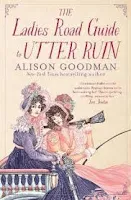
Review: The Ladies Road Guide to Utter Ruin by Alison Goodman


The Ladies Road Guide to Utter Ruin by Alison Goodman


This is the second in Goodman’s “Ill-Mannered Ladies” series, which follows my new favourite twin sisters Lady Augusta (Gus) and Lady Julia Colebrook. I enjoyed the first in the series so much that I pre-ordered this and read it as soon as it was released. The Colebrook twins are fabulous - unmarried, unapologetic, unrelentingly curious and courageous as anyone could hope to be. In this book, the sisters find themselves helping fugitive Lord Evan and his sister, by saving the sister from the clutches of their eldest brother and trying to clear Lord Evan's name of the murder he has been convicted of.  


I actually think I preferred this second instalment to the first. It is so entertaining - Sherlock Holmes meets righteous feminist indignation. I think what improved this story for me was that rather than focusing on several mysteries, it followed the one throughout. What really makes this such an entertaining book is the relationship between Gus and Julia. They are so different, and yet so loyal to one another. They can read each other's minds and yet at times are so exasperating to one another.  I loved them in the first book (The Benevolent Society of Ill-Mannered Ladies), and I loved them even more here. They feel like the kind of women you might want to write old-fashioned letters to and would find highly intelligent and entertaining correspondents. 


And the romance, sigh. Gus continues her slow-burning romance with Lord Evan, who remains on the run from the law. Julia starts her own romance with a bow-street runner, a more subtle romance than that of Gud and Lord Evan, but obviously still deeply felt. What is great about this series is that despite Gus and Julia having romantic interests in the story, they remain committed to what I would call social injustice and the restrictions that society places upon them due to their age and gender.  


I highly recommend this series, written by an Australian author. Start with the The Benevolent Society of Ill-Mannered Ladies and know that it will get even better in The Ladies Road Guide to Utter Ruin. 


Review: Earthly Delights by Kerry Greenwood (Australian)

Kerry Greenwood's Earthly Delights was an easy and enjoyable read.

Earthly Delights is a detective story. The protagonist Corinna Chapman is a straightforward woman who runs her own successful bakery. Like a lot of detective stories, there are a series of mysteries to be solved. Who is the stalker who is threatening all the owners of Corinna's unit block? Is Corinna's new bloke Daniel more than he seems? Why has a junkie ended up dead in Corinna's back yard?

Whilst I can tell you the main mysteries that Corinna was faced with in Earthly Delights, I must admit that for me, months later, the plot is pretty forgettable.

Perhaps some of the plot was lost in amoungst the larger-than-life characters. In Earthly Delights we have a baker, a dominatrix, a Wiccan, a professor, an old married couple, a social worker helping the homeless, computer geeks and stupid young girls. Although this provided great variety, it still struck me as a bit too far-fetched that you find so many unusual individuals all living within a stone's throw of each other and all being involved in one way or another with each other. What else struck me about the characters is that even though each appeared so unique on the surface, somehow or other they all feel so cliched. I felt like I could just tick of the cliches as I went, the hippy witch, the Gen Y girls obsessed with their phones and clothes, the handsome do gooder and so on and so forth.

What I appreciated even less than the cliched characters... were the cats. Corinna Chapman is a cat person. And I am not. I heard far too much about her 3(?) cats and what they got up to.

What I did appreciate was that Greenwood was certainly trying to make a point about drug use and homelessness in Australian society, and how people who live with these issues are viewed by the broader population. As someone who works with people like this, I could identify to a certain extent with the way in which those people were portrayed. Greenwood was able to make her point that sometimes people fall into situations that they can't get themselves out of, and sometimes (only sometimes mind you) some help and compassion can help those people make some positive change in their lives.

Earthly Delights is a harmless and enjoyable read. Fun read... but nothing special. I suppose it didn't help that I read it straight after having read The No. 1 Ladies Detective Agency by Alexander McCall Smith. They were, despite their different settings, similar in terms of having a strong female protagonist with a variety of mysteries to solve, and her own personal history to come to terms with. And yet The No. 1 Ladies Detective Agency delivered this in a unique manner without any cliches. And, at heart, I am still a Phryne Fisher girl when it comes to Kerry Greenwood.


5.5 / 8
Enjoyable. I would recommend it if you are looking for an easy read to fill some time. 


Do you ever feel that your feelings about a certain book is affected by the book you read before it?
  I would be interested to hear when it has happened to you and how you felt the book effected your reading of the following one. 


Originally posted 20 November 2012

Review: The Case of the Missing Servant by Tarquin Hall

The first book in Tarquin Hall's Vish Puri detective series, The Case of the Missing Servant, sounded fun and promising. With a quote like this on the back "If Mma Ramotswe is an African Marple, Puri is an Indian Poirot…" I didn't think I could go wrong.

Here's a taste of what you can expect from this book: 

"Meet Vish Puri, India's most private investigator. Portly, persistent and unmistakably Punjabi, he cuts a determined swathe through modern India s swindlers, cheats and murderers. In hot and dusty Delhi, where call centres and malls are changing the ancient fabric of Indian life, Puri s main work comes from screening prospective marriage partners, a job once the preserve of aunties and family priests. But when an honest public litigator is accused of murdering his maidservant, it takes all of Puri s resources to investigate. How will he trace the fate of the girl, known only as Mary, in a population of more than one billion? Who is taking pot shots at him and his prize chilli plants? And why is his widowed Mummy-ji attempting to play sleuth when everyone knows Mummies are not detectives? With his team of undercover operatives Tubelight, Flush and Facecream Puri ingeniously combines modern techniques with principles of detection established in India more than two thousand years ago -- long before that Johnny-come-lately Sherlock Holmes donned his Deerstalker. The search for Mary takes him to the desert oasis of Jaipur and the remote mines of Jharkhand. From his well-heeled Gymkhana Club to the slums where the servant classes live, Puri's adventures reveal modern India in all its seething complexity."

I really enjoyed this book. It was everything it promised to be.

The mystery was exactly that – quite a mystery. There were many twists and subplots that kept me entertained and it was interesting to watch it all unfold and see the roles that the individuals in the story each played in the resolution.

Hall was also able to work into his story the many different ways of life within India, from the slums to the middle and upper classes. I imagine that what I read was an accurate portrayal of the lives of many people in India (I say imagine because I have never been there).

If I sound like I am holding back a bit it is because of this: there was nothing original about this book. I know I know. What kind of originality could I possibly expect of a book of this nature? It's been done before; Puri is just a new character in a very well defined literary tradition.

I suppose I didn't expect it to be quite as unoriginal as I felt it was. In my mind I couldn't help but compare it with Shamini Flint's Inspector Singh Investigates: A Most Peculiar Malaysian Murder. This is a very similar book I read in 2011 that I still felt added something new in a way that The Case of the Missing Servant failed to do. Puri was a bit too close to Poirot for comfort, everything from the round body to the perfect moustache and the affected manners. This may have been done deliberately but it turned me off a little bit I have to admit.

Having said that, please don't let this turn you off the book. It was a very compelling read, with larger than life characters, mystery and heartbreak. For people who enjoy this genre, this is certainly a series you won't regret reading.


5.5 / 8
Enjoyable. I would recommend it.


Do you think I am being a bit harsh expecting something a bit more original from a book like this?


Originally posted 31 January 2012 Page Turners


Review: Dumb Witness by Agatha Christie

Although Dumb Witness may not be one of Christie's finest works, I still found it enjoyable.

Dumb Witness centres around the death of Miss Emily Arundell. On her death, her estate is made over to her companion Miss Lawson, a move that is greatly resented by Miss Arundell's money hungry family. Miss Arudell's death is taken by everyone to be one of natural causes. Hercule Poirot, however, receives a letter some weeks after her death from Miss Arundell herself, outlining her fears that one of her family members is trying to kill her.

Fascinated by the circumstances and convinced that a murder has taken place (despite all initial evidence to the contrary), Poirot cannot help but attempt to bring the murderer to justice.

I did enjoy Dumb Witness because it delivered everything I have come to expect from an Agatha Christie novel. Interesting characters. Tight knit plot. A certain Poirot and a doubting Hastings. A murderer I could never have guessed at. In short, a page turner.

I do have two complaints. Firstly, some of the story elements were too farfetched and too convenient, even for a Christie novel (I am thinking of that nail, string and varnish being set up in the middle of the night for example). Secondly, the story was just a little lacklustre compared to her normal fare. There was no real drama or compelling force pulling me into the novel. Instead, it just plodded along from one event to the next without any great feeling of… 'oomph' so to speak.


6 / 8
Really enjoyable and well written. I would recommend it.


Have you read Dumb Witness, and did you find it lacklustre compared to some of her other books? What other Christie books have you found a little disappointing?


Originally posted 9 January 2011 Page Turners

Review: Diamond Dove by Adrian Hyland (Australian)

Adrian Hyland's Diamond Dove came to me as a highly recommended book from some other bloggers. I also listened to a fascinating interview with Adrian Hyland on the ABC Radio National Book Show, where Hyland was interviewed about the sequel to Diamond Dove, Gunshot Road, and also spoke about his 10 year experience living and working with remote Aboriginal communities in northern Australia (click here to listen to the interview).

The books protagonist, Emily Tempest, was born to a white father and Aboriginal mother. Although she identifies as Aboriginal, she has always moved freely between the communities and has never been quite sure of where she belongs.

The book begins with her return to Moonlight Downs, the property on which she grew up to which her Clan has been awarded Native Title rights. Her return, however, is not smooth and she soon finds herself embroiled in an investigation when one of the elders, also her old friend, is found murdered and a mentally unstable Aboriginal man named Blakie is blamed for the murder. Initially, Emily sets out to help the police capture Blakie who disappears after the murder. Instead, what she uncovers are a series of strange events and occurrences that lead her to think that Blake may not be responsible for the murder at all. So follows the story of Emily's adventures as she tries to solve the crime and come to terms with her own identity in the process.

The story in Diamond Dove had a lot of promise, but sadly, for me, it just wasn't realised. In Diamond Dove, we see the clash of traditional customs and beliefs with the attraction of larger more urban communities. Hyland also uses the story to explore the practical side of native title land rights and what it means for the traditional custodians and white owners of the land.

My complaint is that the plot itself moved too slowly and lacked a sufficient amount of tension that would have been fitting for what is essentially a work of detective fiction. Perhaps Hyland was trying to mirror the pace of life in the outback for these isolated communities but, in the end, I was willing the book to pick up pace. I also found the characterisation somewhat lacking. I wanted the characters to be more fully formed and a little deeper than they were.

Although the traditions of detective fiction are observed here, I did appreciate the uniqueness that the outback setting brought to the story.


5 / 8
Good and worth reading if you have the opportunity, but there's no need to prioritise it.


Do you appreciate it when an author uses the conventions of a traditional genre, but sets their story in a more unique or unusual time or place?

Also, let me know what you thought of this book if you have read it. I would be very interested to hear your view on Hyland's depiction of this Aboriginal community.


Originally posted 11 December 2011 Page Turners


Review: 4:50 from Paddington by Agatha Christie

This is barely a review, more a nod in the direction of Agatha Christie – whose books I love reading but reviewing them can sometimes become a little repetitive.

4:50 From Paddington is the story of Miss Marple's investigation into a murder that took place on a train. Her friend Mrs McGillicuddy arrives at her door one day with a story about seeing a woman murdered on a train. The police don't believe her because no body was recovered, but Miss Marple knows better.

She uses her personal common-sense approach to come to the realisation that the body must be hidden somewhere at Rutherford Hall, an old family home alongside the railway tracks. She arranges a friend of hers to gain employment at Rutherford Hall and do some investigations into the family.

These investigations lead to a whole host of hidden secrets, but Miss Marple is determined to catch the killer before they kill again.
 
Not one of Christie's best, but then I am more of a Poirot fan than a Marple fan. Miss Marple herself barely lifted a finger to help solve this crime and the other characters didn't have enough charisma to keep me interested in their plight.

All in all, the story was a bit slow and…. English for my tastes. I know that sounds crazy, but there you have it.


5.5 / 8
Enjoyable. I would recommend it to Christie fans.

Did you feel a bit..... blah, about this one?


Originally posted 6 December 2011 Page Turners

Review: And Then There Were None by Agatha Christie (her highest selling book)


And Then There Were None
is Agatha Christie's most popular novel and one of the best-selling novels of all time.


Eight different and otherwise unknown to each other people are invited by an old acquaintance to stay on Indian Island (originally Nigger Island). When they arrive, they discover that although there are two additional people on the island, the help, their host has yet to arrive. The boat that took them there has left and they find themselves stranded. Each person has the poem "Ten Little Niggers" framed on the wall of their room. On their first evening there, they discover that they have been trapped on an island by a person determined to kill them all one by one – and that person must be one of their number. And yet, at the close of the book, all ten people are dead.

Who killed them?

I was very taken by this story and had absolutely no idea until it was revealed at the end who the murderer could possibly have been. It was certainly very creative story telling on Miss Christie's part, but I can't help but wonder what makes it the most popular of all her books, to the point where it is one of the highest selling books of all time? It certainly has a lot of murders, more so than any other of her books. And it has one of the trickiest endings to figure out in my view. But I missed having a central detective to follow around as they attempted to solve the crime.

The book was originally published as Ten Little Niggers, but for obvious reasons it was renamed in the 60s as And Then There Were None. For myself, there are other books I have enjoyed more than this one. I think though I am a little biased toward the Hercule Poirot novels, I just can't help myself.


6.5 / 8
Really enjoyable and well written, couldn't put it down. I would recommend it.


Is this Agatha Christie one of your favourites and what's your theory about why this one might be her most popular novel?


Originally posted 22 November 2011 Page Turners


Review: The Mysterious Affair at Styles by Agatha Christie

The Mysterious Affair at Styles is Agatha Christie's first published novel and therefore the world's first introduction to the wonderfulness that is Hercule Poirot.

This has always been one of my favourite Christie novels, even before I realised it was her first published work. I read it over and over again as I was growing up, but always with enough time between readings to forget who the criminal was. Now sadly, I have read it so much that I can't forget 'who did it' but I still enjoy it, nevertheless.

The narrator, like most (all?) of her Poirot novels is Hastings. He is resting after an injury in the war and is invited to stay at a country property, Styles, with an old friend. While there, he finds himself embroiled in family drama as the matriarch of the family, Emily Cavendish, is poisoned, and it is clear that someone in the house must be responsible for it.

By luck, Hastings runs into his old friend Poirot, who on the request of hastings and the family, sets to work using his little grey cells to solve the murder.

I really loved that the Poirot introduced in this book is the Poirot we see in all the books. Christie just got his character so spot on right from the very beginning that he is thoroughly consistent throughout all the books in which he appears. He finds himself in England as a refugee from the war, a fact that had escaped my notice until this reading of the book.

In this book we also have the varied cast of characters upon whom suspicion is thrown. There is Alfred Inglethorpe, Emily's new and much younger husband upon whim suspicion in naturally initially thrown. There are her sons, Lawrence and John Cavendish, both of whom have their own motives for doing away with their mother. Also in the house is Mary Cavendish, John's beautiful but unsatisfied wife who may or may not be having an affair with the dark and handsome toxicologist (yes, a very suspicious profession when someone has been poisoned) Dr Bauerstein. There is Cynthia Murdoch, an orphan who has been taken into the family and of course the eccentric Evelyn Howard, Emily longest friend and paid companion.

Then of course there are the marvellous clues that Christie scatters throughout the book. Who left the footprints outside the window? Why is there a green fabric caught in the latch of the murdered woman's bedroom door? Can Cynthia really be that sound a sleeper? Who was arguing with Emily on the day of her death and what was that argument about? Why is there a crushed coffee cup on the floor of the bedroom, next to a puddle of candle wax?

Despite it being her first work, this is a book that is bound to keeping you guessing until the end.


6 / 8
Really enjoyable and well written. I would recommend it. 


Did you realise that this was Christie's first novel when you read it (if you have read it)? If you didn't, does it change the way you think about the book?


Originally posted 13 November 2011 Page Turners

Review: The Black Russian by Lenny Bartulin

I first heard of Lenny Bartulin's The Black Russian, when it was shortlisted for the 2010 Ned Kelly Award for crime writing. After leaving a comment on one of Bernadette's blogs (see Reactions to Reading and Fair Dinkum Crime) expressing my eagerness to read the book, she kindly sent it to me to read. So, a big thank you to Bernadette for her kindness. Please take some time to have a look at her blogs.

Crime fiction is a greatly underrated genre, and so recently I have been deliberately making and effort to explore it further.

Lenny Bartulin's The Black Russian ticked a lot of boxes for me. It was crime fiction, it was Australian, it was set in Sydney (my hometown), it had a reputation for being funny and, as a bonus, its protagonist was a second-hand bookseller.

It had all the makings of a great read, and Bartulin delivered.

"After yet another slow week at the cash register, Susko Books - that fine purveyor of second-hand literature - is facing financial ruin. Jack Susko heads to a gallery in Woollahra to scrape up some funds with the sale of an old art catalogue. With his characteristic panache and exquisite timing, he arrives just as De Groot Galleries is being done over by masked thieves. Along with a mysterious object from the safe, the robbers seize a valuable first edition from Jack's bag, too.

The owner of the gallery refuses to call the cops, and Jack is offered a sizeable sum to keep silent. But when de Groot arrives at the bookshop with his heavy to renege on the deal, all bets are off. With an ease that almost constitutes a gift, Jack Susko finds himself at the centre of a world full of duplicity, lies and art theft."


Although this might sound a little shallow, what I enjoyed most about this book was that it was based in Sydney, and much of the action took place in areas I am very familiar with. I liked seeing those areas depicted in fiction; roads I drive along several times a week, buses I regularly catch and at one stage, a street my parents in law actually live on. I think Bartulin really captured what Sydney feels like - the weather, the streets, the people. He is able to capture the different atmospheres and lifestyles of Woollahra, the city and the western suburbs for example.

In fact, The Black Russian has a distinctly Australian flavour, expressed in the accuracy of the depiction of the setting as well as the dry Australian humour in Bartulin's writing. 

The characters were perfectly formed stereotypes. There was the money hungry art gallery owner, the evil and morally repugnant crime boss, the femme fatale and of course the cynical and frustrated small business owner. Fortunately, Bartulin was a skilled enough writer to prevent the stereotypes from becoming cartoonish caricatures - thus maintaining the humour that they each provide.

Perhaps another risk Bartulin took was with the entirely implausible plot, but rather than distracting the reader with its implausibility Bartulin provides comedy, larger than life characters, accurate and atmospheric setting and witty one-liners to ensure that the reader sees past the implausibility and becomes drawn into the story.

I would even go so far as to say that the implausibility of it is all is almost part of the point of this book. Bartulin uses the larger than life characters and outlandish plot to poke fun at Sydney's 'try-hard' preoccupation with art, culture and money. 

Although this is a comedy, it is primarily a piece of crime fiction. Scribe Publications, the publisher, has quotes on its website comparing Bartulin's writing to Raymond Chandler and Ian Flemming. I haven't read Ian Flemming, but I think that a direct comparison to Raymond Chandler's work is perhaps taking things a bit far.

There is certainly the influence of the often talked about hard-boiled style of crime fiction writing in Bartulins writing, most clearly in the dialogue of Jack Susko. This was the books main weakness for me, but a weakness I see in a lot of hard-boiled style pieces of crime fiction (and so probably more a question of personal preference than weakness). A lot of the time Jack Susko's sarcastic sense of humour is very funny, but at other times it felt false and unauthentic. Consider these exchanges in the early part of the book between Jack Susko and the two thieves who are holding him at gun point.

In the first exchange, Jack Susko is being duct taped to a chair by one of the thieves:
"'Nice mask,' said Jack. 
Shane ignored him, concentrated on winding the tape.
'Why didn't you wear the cape?'
'Lone Ranger doesn't wear a cape.'
'You mean you're not the Scarlet Pimpernell?'"
The second exchange takes place as the second thief goes through Jack Susko's bag and pulls out his copy of a valuable first edition Ian Flemming book:
"Walter picked up Jack's bag from the floor. He lifted the flap and had a good look inside. He pulled out a package and waved it around. 'What's this then?'
'A bomb,' said Jack."
Maybe it's the criminal solicitor in me, but I can't suspend my sense of reality quite enough to believe that this is how any person would react when being held up and robbed at gun point, I don't care how financially unstable they are.

Ultimately, The Black Russian is an incredibly humorous book. It is the second in a series of three books, A Deadly Business, The Black Russian and De Luxe. Although I hadn't read the first book in the series this didn't affect in any way my understanding or enjoyment of this one.

You could read this book if you were looking for a witty example of modern-day crime fiction with a good dose of black humour. It is also a good book for a person who is interested in reading an accurate depiction of the people, the life and the atmosphere of the Sydney I know and love.


 6 / 8
Really enjoyable and well written. I would recommend it.

Have you ever read a book set exactly where you live and in the time that you live? What did you think of the depiction of your city?


Originally posted 9 November 2011 Page Turners

Review: The Secret Adversary by Agatha Christie


Agatha Christie has a whole host of different detectives, and it is in The Secret Adversary that Tommy and Tuppence are introduced to the world. 


There's not a whole lot to Agatha Christie novels, so I won't torment you with a long and boring review.

What I really enjoyed about this plot was that it was significantly more complicated than most of her other books in my experience. I appreciated the complexity of it; it built the tension up nicely and kept me guessing close to the end.

Having said that, what I also loved about this book was that I actually guessed who the 'bad-guy' was before the end of the book, something I rarely accomplish with a good Christie novel.

Tommy and Tuppence are not my favourite of Agatha Christie's detectives, but they fit the nature of this plot very effectively.

If you are a Christie fan but are looking for something a bit out of the usual, then this could be a good choice for your next Agatha Christie read.


6 / 8
Really enjoyable and well written. I would recommend that you read it.

Are Tommy and Tuppence your favourite Agatha Christie detectives? Feel free to share your thoughts of this one if you have read it.


Originally posted 23 September 2011 Page Turners

Inspector Singh Investigates: A Most Peculiar Malaysian Murder by Shamini Flint

For those of you enjoy quality writing and a fun modern-day murder mystery then Inspector Singh Investigates: A Most Peculiar Malaysian Murder by Shamini Flint is for you.

I don't ordinarily start my reviews with the blurb from the back cover, but in this case I couldn't help myself:
"Inspector Singh is in a bad mood. He's been sent from his home in Singapore to Kuala Lumpur to solve a murder that has him stumped. Chelsea Liew - the famous Singaporean model - is on death row for the murder of her ex-husband. She swears she didn't do it, he thinks she didn't do it, but no matter how hard he tries to get to the bottom of things, he still arrives back at the same place - that Chelsea's husband was shot at point blank range, and that Chelsea had the best motivation to pull the trigger: he was taking her kids away from her. Now Inspector Singh must pull out all the stops to crack a crime that could potentially free a beautiful and innocent woman and reunite a mother with her children. There's just one problem - the Malaysian police refuse to play ball."
Shamini Flint's A Most Peculiar Malaysian Murder is one of the more unique modern-day murder mysteries that I have read.

I will also go out on a limb and say that Inspector Singh is one of the most unique fictitious detectives I have ever had the joy to read. He is essentially an unpopular grumpy middle-aged police officer sent from his home in Singapore to investigate a murder in Malaysia where the prime suspect is already in custody.

Despite the obstacles in his way, not least of which is his excessive weight in the tropical heat of Malaysia, he slowly but surely investigates the murder in an attempt to clear the name of the prime suspect Chelsea Liew who is accused of killing her husband.

Chelsea Liew is a Singaporean national, who married a Malaysian business tycoon Alan Lee many years before but whose marriage to her husband is going through the family law courts as he attempts to divorce her and take permanent custody of their children. The Lee family business comes from logging the forests in nearby countries. Inspector Singh's investigations lead him into the murky world of the logging industry and the atrocities such companies commit.

What I loved most about this book was not just the plot (which was definitely a page turner). In A Most Peculiar Malaysian Murder, Shamini Flint effectively evokes the feel of the city and the characters. I felt hot and sweaty as I read Inspector Singh walk through the hot and dusty streets of Kualar Lumpur, and felt for Chelsea Liew's son when he discovered his fathers betrayal.

Flint also provides us with an insight into Malaysian culture and religion and how these issues permeate the every day lives (and the legal system) of its people. Although the book is a fun and easy read, Flint has managed to weave in amoungst the plot important religious and environmental issues that in the Western world we otherwise wouldn't give a lot of thought too.

A Most Peculiar Malaysian Murder is the first in a series and I can't wait to read of Inspector Singh's adventures.


6.5 / 8
Really enjoyable and well written, couldn't put it down. Worth buying if you like to re-read your murder mysteries when you have let enough time pass to forget who committed the murder.


Do you think that a light-hearted detective fiction book can ever really effectively blend a fascinating plot with religious and cultural themes to create a great story? 

Originally posted 25 August 2011 Page Turners

A Child's Book of True Crime by Chloe Hooper

I really don't know what to make of Chloe Hooper's A Child's Book of True Crime.

It came to me as a recommendation from someone that I really trust but this book was really quite dark and creepy, which stopped me from really enjoying the story.

The plot is centred on Kate Byrne, a young primary school teacher who commences an affair with a parent of one her favourite students. Her lover's wife, Veronica, has just written a true crime novel about the murder of a young girl, Ellie Siddell, who was murdered by her own lover's wife when she discovered their affair.

The novel is written from the perspective of Kate, who appears to become increasingly caught up in some paranoid delusion in which she believes that she will share the same fate as Ellie Siddell. In fact, some of the book is Kate's own reimagining of Ellie Siddell's murder in the form of a children's book, with the story presented through the eyes of a community of native animals. Even this story differs from what we learn are the real facts known about the murder, and it differs in a way that suits what Kate would have us believe about the murdered girl.

Kate is an unlikeable character and an untrustworthy narrator. Is her life in danger or is it in her head? I still don't feel as though I know the answer.

Hooper herself is clearly an extremely talented writer. There are so many themes that are cleverly woven in amongst Kate paranoid musings. She provides us with some really interesting, and no doubt well-researched, insights into the minds of children. She also explores the dynamics of a relationship between an older married man and a young female. She also gives us an insight into the mind of someone who is arguably mentally ill.

It was undoubtedly a unique novel. I don't feel as though I have read anything like it before, and I doubt that I will ever read anything like it again.

But A Child's Book of True Crime didn't achieve anything in particular. I was left wanting, thinking to myself "yeah, and….." Hooper delved so deep into the character that there was not sufficient plot to balance with the intense characterisation.

I was left feeling unsatisfied and disturbed at the end of this book. If this is what Hooper was setting out to achieve, then she did it successfully. If there was some deeper purpose to this book (and it reads as though there should be), then it was lost on me.

This book will not receive a rating because I can't quite place my feelings about it.


Please let me know what you thought of this book if you have read it. Did you get it? Was there something more that I am missing or is this simply the musings of a woman slowly losing her mind? If it is, why is that so unsatisfying? 

Originally posted 14 June 2011 Page Turners

By the Pricking of My Thumbs by Agatha Christie


Agatha Christie’s By the Pricking of My Thumbs is one of the strangest Christie’s novels I have read for a long time, perhaps ever.


It is a Tommy and Tuppence novel, not two of my favourites of her characters, but I will admit that I liked the more mature Tommy and Tuppence in this novel. When Tommy’s great Aunt Ada passes away Tuppence becomes involved the disappearance of an apparently nice old lady. Tuppence doesn’t give much credit to her assertions of a murdered child inside the fireplace, but the more Tuppence investigates the disappearance, the closer she comes to the truth of the child behind the fireplace and the bigger the danger she places herself in.


By the Pricking of My Thumbs didn’t seem to receive good reviews when it was published. I imagine it is because this book feels a lot less like her plot driven mysteries where Piorot and Marple try to figure out the clues, and a lot more like a modern-day crime novel or thriller. There are not the clues throughout the book to figure out the resolution to the mystery, but the book is still as tense as Christie’s other books, and perhaps even a little more melodramatic than usual.

Although it wasn't her usual style of story, I enjoyed it a lot and kept reading it until the very end.


6 / 8 
Really enjoyable and well written. I would recommend it.


I would love to know what you thought of this Christie mystery of you have read it. What did you think of an older Tommy and Tuppence, and did you think that this quite different to her usual stories/?


Originally posted 18 April 2011 Page Turners

Death Before Wicket by Kerry Greenwood


In Death Before Wicket, the sophisticated and debonair The Honourable Miss Phryne Fisher visits Sydney, ostensibly for a holiday, but also because she has been summoned there by two young university men to solve the mystery of some missing university documents, which were stolen from a safe at Sydney University. A friend of these young men has been blamed for the theft and they hope that Phryne can clear his name.

Phryne takes on this seemingly simple problem but soon finds herself embroiled in a mystery involving curses and black magic. The deeper she delves in the mystery the more danger she places herself in.

Her investigations into this matter are of course complicated by the fact that upon returning to Sydney, her faithful companion Dot discovers that her sister has disappeared, leaving her husband and children behind. Phryne attempts to discover the whereabouts of the missing woman, but her investigations lead her into the seedier side of Sydney life, and she has to try to discover the truth without hurting Dot's feelings or Catholic sensibilities.

I did enjoy this book, although strangely not quite as much as I have her others. I think that is because the change of setting from Melbourne to Sydney may have distracted me a little bit. Having said that, Greenwood's depiction of 1920's Sydney is spot on. She captures the people of Sydney, the atmosphere and of course the heat (something I am very familiar with, especially this week with temperatures reaching almost 40C (104F) every day) so wonderfully that I felt as though I was right there in the 'heat' of the moment with Phryne.

The plot in Death Before Wicket was the most complicated plot I have read in a Phryne Fisher mystery, and whilst that sometimes made it a bit harder to follow than the other books in the series, it still added to the mystery.

Phryne herself was as sophisticated in Sydney as she is in Melbourne. As usual, my mouth watered at the descriptions of all the food and the drink that they all consume, and I was particularly taken aback by the raunchiest sex I think Phryne has ever had (that I have read about anyway!).

All in all, a fabulous read and I can't wait to get my hands on another one in this series.


6.5 / 8
Really enjoyable and well written, couldn't put it down. Recommend that you buy it.

 
Do you enjoy reading books that are based in your own city? What do you enjoy about them?


Originally posted 16 February 2011 Page Turners